Skip to content

Mathematics · Ch 5 — Two Dimensional Analytical Geometry-II

Parametric Equations of the Circle, Parabola, Ellipse and Hyperbola

5.5.1

Parametric Equations of the Circle, Parabola, Ellipse and Hyperbola

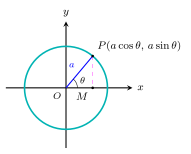
(i) Circle x2+y2=a2x^2+y^2=a^2. Let P(x,y)P(x,y) be a point on the circle, OPOP making angle θ\theta with the xx-axis, and MM the foot of the perpendicular from PP to the xx-axis. From right triangle OPMOPM: x=OM=acos⁡θx=OM=a\cos\theta, y=MP=asin⁡θy=MP=a\sin\theta. So x=acos⁡θ, y=asin⁡θx=a\cos\theta,\ y=a\sin\theta (0≤θ≤2π0\le\theta\le2\pi) parametrise the circle; conversely, squaring and adding recovers x2+y2=a2cos⁡2θ+a2sin⁡2θ=a2x^2+y^2=a^2\cos^2\theta+a^2\sin^2\theta=a^2.

(ii) Parabola y2=4axy^2=4ax. For P(x1,y1)P(x_1,y_1) on the parabola, y12=4ax1y_1^2=4ax_1. Writing y12a=t\dfrac{y_1}{2a}=t (an arbitrary real number, since y1y_1 ranges over all reals), y1=2aty_1=2at and then x1=y124a=(2at)24a=at2x_1=\dfrac{y_1^2}{4a}=\dfrac{(2at)^2}{4a}=at^2. So x=at2, y=2atx=at^2,\ y=2at (−∞<t<∞-\infty<t<\infty) parametrise the parabola; eliminating tt (i.e. t=y/2at=y/2a) recovers y2=4axy^2=4ax.

(iii) Ellipse x2a2+y2b2=1\dfrac{x^2}{a^2}+\dfrac{y^2}{b^2}=1. Let PP be on the ellipse and QQ the corresponding point directly above/below it on the auxiliary circle x2+y2=a2x^2+y^2=a^2, with ∠ACQ=α\angle ACQ=\alpha (so Q=(acos⁡α,asin⁡α)Q=(a\cos\alpha,a\sin\alpha)). Since PP shares its xx-coordinate with QQ, x=acos⁡αx=a\cos\alpha; substituting into the ellipse equation and solving for yy gives y=bsin⁡αy=b\sin\alpha. So P=(acos⁡α,bsin⁡α)P=(a\cos\alpha,b\sin\alpha); the parameter α\alpha (or θ\theta) is called the eccentric angle of PP — note carefully that θ\theta is the angle CQCQ makes with the xx-axis, not the angle CPCP makes with it. So x=acos⁡θ, y=bsin⁡θx=a\cos\theta,\ y=b\sin\theta (0≤θ≤2π0\le\theta\le2\pi) parametrise the ellipse.

(iv) Hyperbola x2a2−y2b2=1\dfrac{x^2}{a^2}-\dfrac{y^2}{b^2}=1. By an entirely analogous construction (using sec⁡2θ−tan⁡2θ=1\sec^2\theta-\tan^2\theta=1 in place of cos⁡2θ+sin⁡2θ=1\cos^2\theta+\sin^2\theta=1), x=asec⁡θ, y=btan⁡θx=a\sec\theta,\ y=b\tan\theta parametrise the hyperbola, for −π≤θ≤π-\pi\le\theta\le\pi, θ≠±π/2\theta\ne\pm\pi/2.

Reference table.

ConicParametric equationsParameter rangePoint notation
Circle x2+y2=a2x^2+y^2=a^2x=acos⁡θ, y=asin⁡θx=a\cos\theta,\ y=a\sin\theta0≤θ≤2π0\le\theta\le2\pi(acos⁡θ,asin⁡θ)(a\cos\theta,a\sin\theta), or just "θ\theta"
Parabola y2=4axy^2=4axx=at2, y=2atx=at^2,\ y=2at−∞<t<∞-\infty<t<\infty(at2,2at)(at^2,2at), or "tt"
Ellipse x2a2+y2b2=1\frac{x^2}{a^2}+\frac{y^2}{b^2}=1x=acos⁡θ, y=bsin⁡θx=a\cos\theta,\ y=b\sin\theta0≤θ≤2π0\le\theta\le2\pi(acos⁡θ,bsin⁡θ)(a\cos\theta,b\sin\theta), or "θ\theta"
Hyperbola x2a2−y2b2=1\frac{x^2}{a^2}-\frac{y^2}{b^2}=1x=asec⁡θ, y=btan⁡θx=a\sec\theta,\ y=b\tan\theta−π≤θ≤π, θ≠±π2-\pi\le\theta\le\pi,\ \theta\ne\pm\frac\pi2(asec⁡θ,btan⁡θ)(a\sec\theta,b\tan\theta), or "θ\theta"
Figure 5.44,5.47Parametric form of a circle $x^2+y^2=a^2$: a point $P(a\cos\theta,\,a\sin\theta)$ at parameter angle $\theta$, with radius $a$ and foot $M$ on the $x$-axis
Fig. 5.44,5.47 — Parametric form of a circle $x^2+y^2=a^2$: a point $P(a\cos\theta,\,a\sin\theta)$ at parameter angle $\theta$, with radius $a$ and foot $M$ on the $x$-axis

Drawn by us to help you understand the concept clearly, and verified to make sure it's accurate. For exams, practice from your textbook's own diagram.

What this figure shows. P(x,y)P(x,y) on the circle located by the angle θ=∠POM\theta=\angle POM at the centre; and PP on the ellipse located via QQ, its corresponding point on the auxiliary circle at eccentric angle α\alpha, showing why P=(acos⁡α,bsin⁡α)P=(a\cos\alpha,b\sin\alpha). …