Physical Education · Ch 7 — Fundamentals of Anatomy and Physiology in Sports
Properties and Functions of Muscles
Properties and Functions of Muscles
Muscles are responsible for all movement in the body, because movement is produced by the contraction and relaxation of muscles. This movement may be voluntary or involuntary: the pumping of blood by the heart is an example of involuntary movement, while running or walking is an example of voluntary movement.
Types of muscle tissue
There are three types of muscle tissue, differing in their structure, location and control.
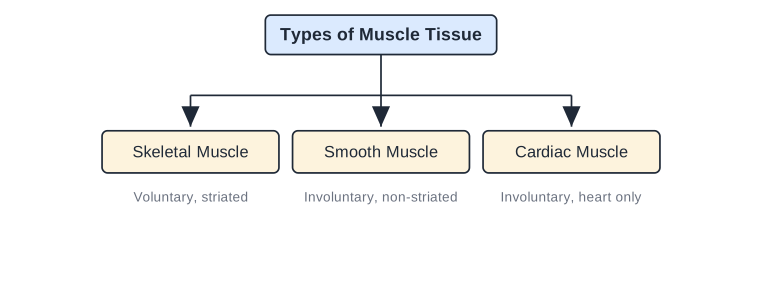
Drawn by us to help you understand the concept clearly, and verified to make sure it's accurate. For exams, practice from your textbook's own diagram.
A chart headed 'Types of Muscle Tissue' with a line dropping to three labelled boxes side by side: Skeletal Muscle, Smooth Muscle and Cardiac Muscle. Read it alongside the comparison table in the text: Skeletal Muscle is the voluntary, striated muscle attached to the bones; Smooth Muscle is the involuntary, non-striated muscle of hollow organs and vessels; Cardiac Muscle is the involuntary, striated muscle found only in the walls of the heart. The chart is a quick reminder that the …
1. Skeletal muscles
Skeletal muscles make up about 40% of the body weight. They are attached to the skeletal system by tendons and have the ability to exert force. They are also called striated muscles, because their striations (stripes) can be seen under a microscope. They are voluntary - we can control them at will, as in walking, running, smiling and eating. Skeletal muscles can contract most rapidly, but not for long periods, as that tires the muscle.
2. Smooth muscles
Smooth muscles have elongated, slender, spindle-shaped cells and do not have striations. They are involuntary - their contraction or expansion is not under our control - and they contract much more slowly than skeletal or cardiac muscles. They are found mostly in the hollow organs, such as the stomach, urinary bladder and respiratory passages. Smooth muscle is also present in the eyes, where it changes the size of the iris and alters the shape of the lens, and in the skin, where it makes the hair stand erect in response to cold or fear.