Biology · Ch 14 — Breathing and Exchange of Gases
Human Respiratory System
Human Respiratory System
The human respiratory system is a continuous passage that carries outside air deep into the lungs, where the actual exchange of gases happens. It can be traced as a single route from the nose down to microscopic air sacs.
The pathway of air
- External nostrils open above the upper lips and lead into the nasal chamber through the nasal passage.
- The nasal chamber opens into the pharynx, a region that serves as a shared passage for both food and air.
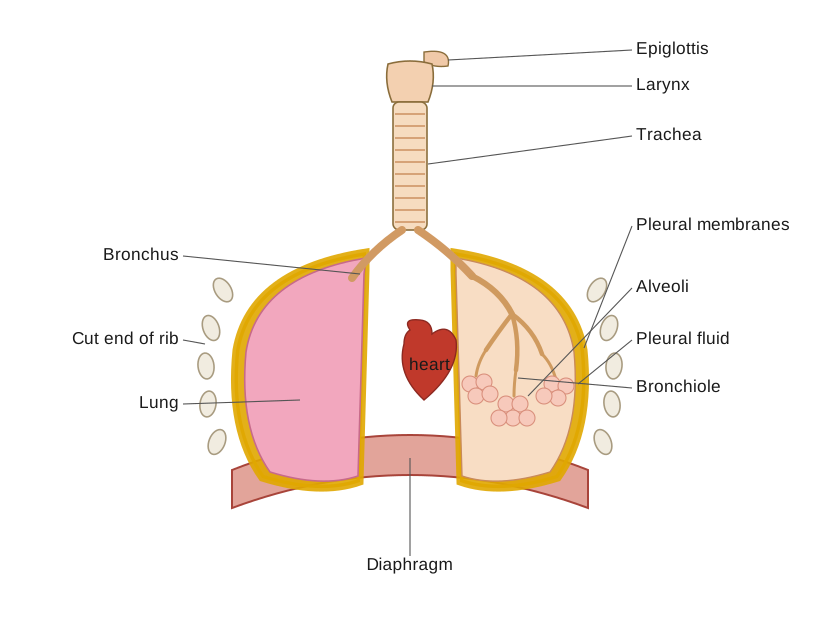
- The pharynx connects, through the larynx, into the trachea. The larynx is a box made of cartilage that helps produce sound, which is why it is called the sound box.
- During swallowing, a thin, elastic, cartilaginous flap called the epiglottis can cover the opening of the larynx (the glottis), preventing food from entering the airway.
- The trachea is a straight tube running down to the middle of the thoracic cavity. At the level of the fifth thoracic vertebra it splits into a right and left primary bronchus.
- Each primary bronchus divides again and again into secondary and tertiary bronchi and then into bronchioles, which finally narrow into very fine terminal bronchioles.
- Every terminal bronchiole ends in a cluster of very thin, irregular-walled, richly-vascularised, bag-like sacs called alveoli.
The trachea, the primary, secondary and tertiary bronchi, and the first bronchioles are held open by incomplete rings of cartilage, which keep the airways from collapsing.
The lungs and their covering
The whole branching system of bronchi, bronchioles and alveoli together makes up the lungs. There are two lungs, each wrapped in a double-layered pleura with pleural fluid in the gap between the two membranes; this fluid reduces friction against the lung surface as it moves. The outer pleural membrane lies against the thoracic wall lining, while the inner pleural membrane clings to the surface of the lung itself.
Conducting part versus exchange part
The respiratory system is functionally divided into two portions:
- Conducting part — from the external nostrils down to the terminal bronchioles. It transports atmospheric air towards the alveoli, cleans it of foreign particles, humidifies it, and brings it to body temperature. No gas exchange happens here.
- Respiratory (exchange) part — the alveoli and their ducts. This is the actual site where oxygen and carbon dioxide diffuse between the blood and the air.
The thoracic chamber
The lungs sit inside the thoracic chamber, an air-tight box bounded by:
- the vertebral column at the back (dorsal side),
- the sternum at the front (ventral side),
- the ribs on the sides (lateral), and
- the dome-shaped diaphragm below. …
Drawn by us to help you understand the concept clearly, and verified to make sure it's accurate. For exams, practice from your textbook's own diagram.
This figure traces the human respiratory system as one continuous passage, and the way to read it is to follow the air from top to bottom. Air enters through the external nostrils above the upper lip, passes into the nasal chamber, and then reaches the pharynx, the shared crossroads for food and air. From the pharynx it moves through the larynx — the cartilage sound box guarded by the flap-like epiglottis that folds over during swallowing — and into the trachea, the straight tube running down the chest. Notice where the trachea forks into a right and left primary bronchus, one entering each lung. Inside the lungs, follow how each bronchus branches repeatedly into secondary and tertiary bronchi and then into finer and finer bronchioles, ending at the terminal bronchioles. Each of …