Biology · Ch 12 — Respiration in Plants
Amphibolic Pathway
Amphibolic Pathway
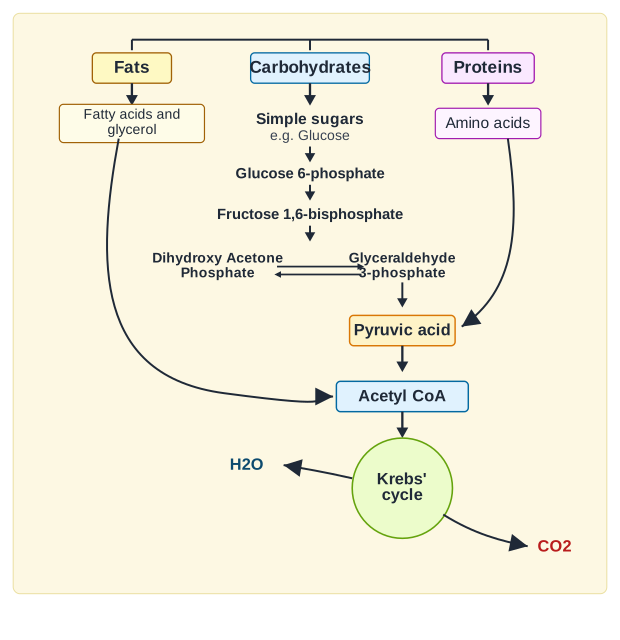
Glucose is the favoured substrate for respiration. All carbohydrates are usually first converted into glucose before they are used for respiration. Other substrates can also be respired, but then they do not enter the respiratory pathway at the first step. The points of entry of different substrates are:
- Fats would first need to be broken down into glycerol and fatty acids. If fatty acids were to be respired they would first be degraded to acetyl CoA and enter the pathway. Glycerol would enter the pathway after being converted to PGAL.
- Proteins would be degraded by proteases, and the individual amino acids (after deamination), depending on their structure, would enter the pathway at some stage within the Krebs' cycle or even as pyruvate or acetyl CoA.
Since respiration involves the breakdown of substrates, the respiratory process has traditionally been considered a catabolic process, and the respiratory pathway a catabolic pathway. But is this understanding correct? The very compounds that would enter the respiratory pathway to be respired and used to derive energy are the same compounds that would be withdrawn from the respiratory pathway for the synthesis of those substrates. For example, fatty acids would be broken down to acetyl CoA before entering the respiratory pathway when used as a substrate; but when the organism needs to synthesise fatty acids, acetyl CoA would be withdrawn from the respiratory pathway. Hence the respiratory pathway comes into the picture both during breakdown and synthesis of fatty acids. Similarly, during the breakdown and synthesis of protein too, respiratory intermediates form the link. …
Drawn by us to help you understand the concept clearly, and verified to make sure it's accurate. For exams, practice from your textbook's own diagram.
This figure shows the respiratory pathway as an amphibolic hub where fats, carbohydrates and proteins all feed in. Carbohydrates give simple sugars like glucose, which passes through glucose-6-phosphate, fructose 1,6-bisphosphate and the triose phosphates (dihydroxyacetone phosphate and glyceraldehyde-3-phosphate) to pyruvic acid. Fats yield fatty acids and glycerol that enter the pathway, and proteins yield amino acids that join at pyruvic acid or within the cycle. All routes converge on acetyl CoA, which enters Krebs' cycle to release CO2 and H2O. Because these same intermediates can be withdrawn for the synthesis of fats and …