Q.Draw cis and trans isomers of the following compounds. Also write their IUPAC names :
Chain isomerism is not the focus here — this question asks for geometrical (cis-trans) isomerism in alkenes. For (i) CHCl=CHCl, the cis isomer is (Z)-1,2-dichloroethene and the trans isomer is (E)-1,2-dichloroethene. For (ii) C₂H₅C(CH₃)=C(CH₃)C₂H₅, the cis isomer is (Z)-3,4-dimethylhex-3-ene and the trans isomer is (E)-3,4-dimethylhex-3-ene.
Geometrical isomerism arises when rotation about a double bond is restricted and each carbon of the double bond has two different substituents. The key is to check whether each sp² carbon is attached to two different groups — if yes, cis and trans forms exist.
Let’s work through each compound step by step.
Compound (i): CHCl = CHCl
1. Identify the structure.
The formula is C₂H₂Cl₂. Each carbon of the double bond has one H and one Cl. So each carbon is attached to two different groups (H and Cl). This satisfies the condition for geometrical isomerism.
2. Draw the cis isomer.
In the cis isomer, the two identical groups (here, the two H atoms) are on the same side of the double bond. Similarly, the two Cl atoms are also on the same side.
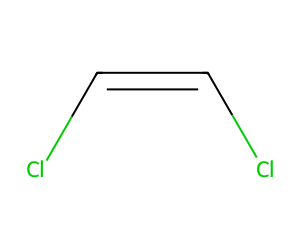
3. Draw the trans isomer.
In the trans isomer, the two H atoms are on opposite sides, and the two Cl atoms are also on opposite sides.
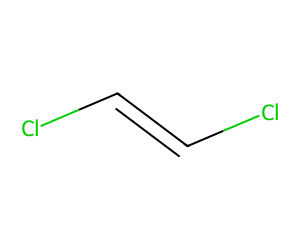
4. Assign IUPAC names.
The parent chain is ethene. The substituents are two chloro groups. For the cis isomer, the two chloro groups are on the same side — this is the (Z) configuration. For the trans isomer, they are on opposite sides — this is the (E) configuration.
The Cahn-Ingold-Prelog priority rules: For CHCl=CHCl, Cl has higher atomic number than H, so Cl is priority 1 on each carbon. In the cis isomer, the two priority 1 groups are on the same side → (Z). In the trans isomer, they are on opposite sides → (E).
- Cis isomer: (Z)-1,2-dichloroethene
- Trans isomer: (E)-1,2-dichloroethene
A common mistake is to write the name as "cis-1,2-dichloroethene" without the (Z) notation. While "cis" is acceptable in simple cases, the IUPAC-preferred name uses (Z) and (E). For exams, always give both the cis/trans label and the (Z)/(E) designation.
Compound (ii): C₂H₅C(CH₃) = C(CH₃)C₂H₅
5. Identify the structure.
This is a symmetrical alkene with four carbon substituents on the double bond. Let’s write it clearly: each carbon of the double bond has one ethyl group (C₂H₅) and one methyl group (CH₃). So each sp² carbon has two different groups — ethyl and methyl — so geometrical isomerism is possible.
6. Draw the cis isomer.
In the cis isomer, the two ethyl groups are on the same side of the double bond, and the two methyl groups are also on the same side.
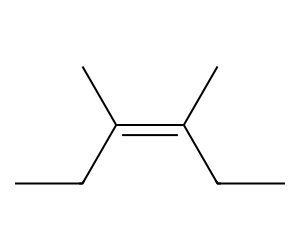
7. Draw the trans isomer.
In the trans isomer, the two ethyl groups are on opposite sides, and the two methyl groups are also on opposite sides.
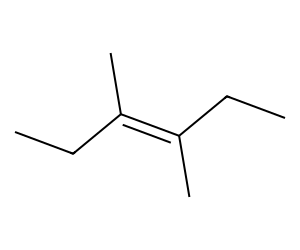
8. Assign IUPAC names.
The longest carbon chain that includes the double bond is six carbons long — hex-3-ene. The double bond is between carbons 3 and 4. There are two methyl substituents at positions 3 and 4. So the base name is 3,4-dimethylhex-3-ene.
Now assign (Z) or (E). Compare the priority of groups on each carbon: ethyl (C₂H₅) has higher priority than methyl (CH₃) because the first atom is carbon in both, but ethyl has a carbon attached to two hydrogens and one carbon, while methyl has a carbon attached to three hydrogens — ethyl wins by the next atom rule.
- In the cis isomer, the two higher-priority groups (ethyl) are on the same side → (Z).
- In the trans isomer, the two higher-priority groups (ethyl) are on opposite sides → (E).
For an alkene with two different substituents on each carbon, the (Z) isomer has the higher-priority groups on the same side; the (E) isomer has them on opposite sides.
- Cis isomer: (Z)-3,4-dimethylhex-3-ene
- Trans isomer: (E)-3,4-dimethylhex-3-ene
You might also see these named as cis-3,4-dimethylhex-3-ene and trans-3,4-dimethylhex-3-ene. Both are acceptable, but (Z)/(E) is the modern IUPAC standard.
- Cis isomer: (Z)-1,2-dichloroethene; trans isomer: (E)-1,2-dichloroethene.
- Cis isomer: (Z)-3,4-dimethylhex-3-ene; trans isomer: (E)-3,4-dimethylhex-3-ene.
Unlock everything free for 14 days
- Full step-by-step solutions
- Concept-first explanations
- Methods, shortcuts & mistakes
- PYQ mapping + timed mock tests
Full access for 14 days. No credit card required.