Mathematics · Ch 9 — Straight Lines
Distance of a Point From a Line
Distance of a Point From a Line
The Distance of a Point from a Line
The distance of a point from a line is defined as the length of the perpendicular drawn from the point to the line. This is the shortest possible distance between the point and any point on the line.
Consider a line given by the general equation , and a point whose perpendicular distance from we want to find. Drop a perpendicular from to , meeting at point . The length is the required distance .
The perpendicular distance is always taken as a positive quantity. If the point lies on the line itself, the distance is zero.
Derivation of the Distance Formula
The textbook derives the formula using the area of a triangle. Here is the complete reasoning, step by step.
Let the line intersect the -axis at and the -axis at .
Step 1: Find the coordinates of and .
On the -axis, . Substituting into gives , so . Hence .
On the -axis, . Substituting gives , so . Hence .
Step 2: Express the area of triangle in two ways.
The area of can be written as . If we take as the base, then the perpendicular from to is , which is exactly the distance we want. So
From this,
Step 3: Compute using the determinant formula.
The area of a triangle with vertices , , is
Applying this to , , :
Factor out :
The absolute value is crucial — area is always positive. The textbook writes the expression without absolute value signs in the intermediate step, but the final formula uses absolute value for distance.
Step 4: Compute , the distance between and .
Factor out :
Step 5: Substitute into equation (1).
The factors cancel, leaving
Since , we have the required formula.
Understanding the Formula …
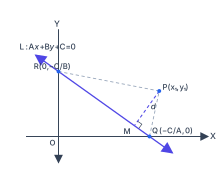
Drawn by us to help you understand the concept clearly, and verified to make sure it's accurate. For exams, practice from your textbook's own diagram.
The figure shows a single straight line drawn on the standard -plane. This line, labelled , has the equation . It cuts the -axis at point and the -axis at point . The coordinates of these intercepts are given directly from the line equation: and . These two points, together with the origin, form the familiar intercept triangle, but that is not the main triangle in the figure.
A point is plotted somewhere off the line — it could be above or below it, the figure does not specify which side. From , a dashed perpendicular segment is drawn down to the line , meeting it at point . A small right-angle mark is placed at to confirm that is indeed perpendicular to . The length of this dashed segment is labelled , and this is the distance of the point from the line .
The figure then completes a triangle by drawing two more dashed segments: one from to and another from to . So the dashed triangle is , with vertices at the external point and the two intercept points and on the axes. The side lies along the line itself, and the perpendicular is the altitude of this triangle from vertex to the base .
The physical idea is simple: the distance from a point to a line is the shortest possible distance, which is always along the perpendicular. The clever trick in the textbook is to avoid directly solving for the foot . Instead, they use the area of in two different ways. First, area equals . Second, area can be computed from the coordinates of , , and using the determinant formula. Equating these two expressions for the same area lets you solve for without ever finding 's coordinates.
Here, is the perpendicular distance from the point to the line . The numerator is the absolute value of the expression obtained by plugging the point's coordinates into the line's left-hand side. The denominator is the square root of the sum of the squares of the coefficients of and . The absolute value is essential because distance is always non-negative, while could be positive or negative depending on which side of the line the point lies.
A common mistake is to forget the absolute value in the numerator. The formula without the modulus gives a signed distance — positive on one side of the line, negative on the other. For pure distance, always take the absolute value.
The derivation itself is a neat piece of coordinate geometry. The length is found using the distance formula between and :
The area of from coordinates is:
…