Skip to content

Mathematics · Ch 3 — Trigonometric Functions

Trigonometric Functions of Sum and Difference of Two Angles

3.4

Trigonometric Functions of Sum and Difference of Two Angles

Trigonometric Functions of Sum and Difference of Two Angles

This section develops the core identities that let you express trigonometric functions of sums and differences in terms of functions of the individual angles. These are the building blocks for everything that follows — double-angle formulas, triple-angle formulas, sum-to-product transformations, and more.

Foundational Results Already Known

Before we begin, recall two basic identities that hold for any angle xx:

  1. sin⁡(−x)=−sin⁡x\sin(-x) = -\sin x
  2. cos⁡(−x)=cos⁡x\cos(-x) = \cos x

These will be used repeatedly in the derivations that follow.


Identity 3: cos⁡(x+y)=cos⁡xcos⁡y−sin⁡xsin⁡y\cos(x + y) = \cos x \cos y - \sin x \sin y

This is the most fundamental addition formula. Everything else in this section flows from it.

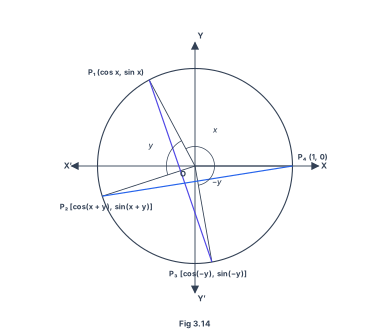
Proof using the unit circle:

Consider a unit circle centred at the origin. Let angle xx be ∠P4OP1\angle P_4OP_1 and angle yy be ∠P1OP2\angle P_1OP_2. Then (x+y)(x + y) is ∠P4OP2\angle P_4OP_2. Also let (−y)(-y) be ∠P4OP3\angle P_4OP_3.

The coordinates of the four points are:

  • P1(cos⁡x,sin⁡x)P_1(\cos x, \sin x)
  • P2[cos⁡(x+y),sin⁡(x+y)]P_2[\cos(x + y), \sin(x + y)]
  • P3[cos⁡(−y),sin⁡(−y)]P_3[\cos(-y), \sin(-y)] — which equals (cos⁡y,−sin⁡y)(\cos y, -\sin y)
  • P4(1,0)P_4(1, 0)

Now consider triangles P1OP3P_1OP_3 and P2OP4P_2OP_4. These triangles are congruent (they have two sides equal — the radii — and the included angle equal). Therefore P1P3=P2P4P_1P_3 = P_2P_4, and consequently P1P32=P2P42P_1P_3^2 = P_2P_4^2.

Compute P1P32P_1P_3^2 using the distance formula:

P1P32=[cos⁡x−cos⁡(−y)]2+[sin⁡x−sin⁡(−y)]2=(cos⁡x−cos⁡y)2+(sin⁡x+sin⁡y)2=cos⁡2x+cos⁡2y−2cos⁡xcos⁡y+sin⁡2x+sin⁡2y+2sin⁡xsin⁡y=(cos⁡2x+sin⁡2x)+(cos⁡2y+sin⁡2y)−2(cos⁡xcos⁡y−sin⁡xsin⁡y)=2−2(cos⁡xcos⁡y−sin⁡xsin⁡y)\begin{aligned} P_1P_3^2 &= [\cos x - \cos(-y)]^2 + [\sin x - \sin(-y)]^2 \\ &= (\cos x - \cos y)^2 + (\sin x + \sin y)^2 \\ &= \cos^2 x + \cos^2 y - 2\cos x\cos y + \sin^2 x + \sin^2 y + 2\sin x\sin y \\ &= (\cos^2 x + \sin^2 x) + (\cos^2 y + \sin^2 y) - 2(\cos x\cos y - \sin x\sin y) \\ &= 2 - 2(\cos x\cos y - \sin x\sin y) \end{aligned}

Now compute P2P42P_2P_4^2:

P2P42=[1−cos⁡(x+y)]2+[0−sin⁡(x+y)]2=1−2cos⁡(x+y)+cos⁡2(x+y)+sin⁡2(x+y)=2−2cos⁡(x+y)\begin{aligned} P_2P_4^2 &= [1 - \cos(x + y)]^2 + [0 - \sin(x + y)]^2 \\ &= 1 - 2\cos(x + y) + \cos^2(x + y) + \sin^2(x + y) \\ &= 2 - 2\cos(x + y) \end{aligned}

Since P1P32=P2P42P_1P_3^2 = P_2P_4^2, we equate:

2−2(cos⁡xcos⁡y−sin⁡xsin⁡y)=2−2cos⁡(x+y)2 - 2(\cos x\cos y - \sin x\sin y) = 2 - 2\cos(x + y)

Cancelling 22 and dividing by −2-2 gives:

cos⁡(x+y)=cos⁡xcos⁡y−sin⁡xsin⁡y\cos(x + y) = \cos x\cos y - \sin x\sin y


Identity 4: cos⁡(x−y)=cos⁡xcos⁡y+sin⁡xsin⁡y\cos(x - y) = \cos x\cos y + \sin x\sin y

Replace yy by −y-y in Identity 3:

cos⁡(x+(−y))=cos⁡xcos⁡(−y)−sin⁡xsin⁡(−y)\cos(x + (-y)) = \cos x\cos(-y) - \sin x\sin(-y)

Using cos⁡(−y)=cos⁡y\cos(-y) = \cos y and sin⁡(−y)=−sin⁡y\sin(-y) = -\sin y:

cos⁡(x−y)=cos⁡xcos⁡y−sin⁡x(−sin⁡y)=cos⁡xcos⁡y+sin⁡xsin⁡y\cos(x - y) = \cos x\cos y - \sin x(-\sin y) = \cos x\cos y + \sin x\sin y

cos⁡(x−y)=cos⁡xcos⁡y+sin⁡xsin⁡y\cos(x - y) = \cos x\cos y + \sin x\sin y


Identity 5: cos⁡(π2−x)=sin⁡x\cos\left(\frac{\pi}{2} - x\right) = \sin x

Take Identity 4 with x=π2x = \frac{\pi}{2} and y=xy = x:

cos⁡(π2−x)=cos⁡π2cos⁡x+sin⁡π2sin⁡x=0⋅cos⁡x+1⋅sin⁡x=sin⁡x\cos\left(\frac{\pi}{2} - x\right) = \cos\frac{\pi}{2}\cos x + \sin\frac{\pi}{2}\sin x = 0\cdot\cos x + 1\cdot\sin x = \sin x

cos⁡(π2−x)=sin⁡x\cos\left(\frac{\pi}{2} - x\right) = \sin x


Identity 6: sin⁡(π2−x)=cos⁡x\sin\left(\frac{\pi}{2} - x\right) = \cos x

Apply Identity 5 to the angle (π2−x)\left(\frac{\pi}{2} - x\right):

sin⁡(π2−x)=cos⁡[π2−(π2−x)]=cos⁡x\sin\left(\frac{\pi}{2} - x\right) = \cos\left[\frac{\pi}{2} - \left(\frac{\pi}{2} - x\right)\right] = \cos x

sin⁡(π2−x)=cos⁡x\sin\left(\frac{\pi}{2} - x\right) = \cos x


Identity 7: sin⁡(x+y)=sin⁡xcos⁡y+cos⁡xsin⁡y\sin(x + y) = \sin x\cos y + \cos x\sin y

Use the cofunction relationship from Identity 5:

sin⁡(x+y)=cos⁡[π2−(x+y)]=cos⁡[(π2−x)−y]\sin(x + y) = \cos\left[\frac{\pi}{2} - (x + y)\right] = \cos\left[\left(\frac{\pi}{2} - x\right) - y\right]

Now apply Identity 4 with xx replaced by (π2−x)\left(\frac{\pi}{2} - x\right) and yy replaced by yy:

cos⁡[(π2−x)−y]=cos⁡(π2−x)cos⁡y+sin⁡(π2−x)sin⁡y\cos\left[\left(\frac{\pi}{2} - x\right) - y\right] = \cos\left(\frac{\pi}{2} - x\right)\cos y + \sin\left(\frac{\pi}{2} - x\right)\sin y

Using Identities 5 and 6:

=sin⁡xcos⁡y+cos⁡xsin⁡y= \sin x\cos y + \cos x\sin y

sin⁡(x+y)=sin⁡xcos⁡y+cos⁡xsin⁡y\sin(x + y) = \sin x\cos y + \cos x\sin y


Identity 8: sin⁡(x−y)=sin⁡xcos⁡y−cos⁡xsin⁡y\sin(x - y) = \sin x\cos y - \cos x\sin y

Replace yy by −y-y in Identity 7:

sin⁡(x+(−y))=sin⁡xcos⁡(−y)+cos⁡xsin⁡(−y)\sin(x + (-y)) = \sin x\cos(-y) + \cos x\sin(-y)

Using cos⁡(−y)=cos⁡y\cos(-y) = \cos y and sin⁡(−y)=−sin⁡y\sin(-y) = -\sin y:

sin⁡(x−y)=sin⁡xcos⁡y−cos⁡xsin⁡y\sin(x - y) = \sin x\cos y - \cos x\sin y

sin⁡(x−y)=sin⁡xcos⁡y−cos⁡xsin⁡y\sin(x - y) = \sin x\cos y - \cos x\sin y


Identity 9: Results for Specific Angle Combinations

By substituting suitable values of xx and yy into Identities 3, 4, 7, and 8, we obtain the following standard results:

ExpressionResult
cos⁡(π2+x)\cos\left(\frac{\pi}{2} + x\right)−sin⁡x-\sin x
sin⁡(π2+x)\sin\left(\frac{\pi}{2} + x\right)cos⁡x\cos x
cos⁡(π−x)\cos(\pi - x)−cos⁡x-\cos x
sin⁡(π−x)\sin(\pi - x)sin⁡x\sin x
cos⁡(π+x)\cos(\pi + x)−cos⁡x-\cos x
sin⁡(π+x)\sin(\pi + x)−sin⁡x-\sin x
cos⁡(2π−x)\cos(2\pi - x)cos⁡x\cos x
sin⁡(2π−x)\sin(2\pi - x)−sin⁡x-\sin x
Note

Similar results for tan⁡x\tan x, cot⁡x\cot x, sec⁡x\sec x, and csc⁡x\csc x can be derived from these sine and cosine results. For example, tan⁡(π−x)=sin⁡(π−x)cos⁡(π−x)=sin⁡x−cos⁡x=−tan⁡x\tan(\pi - x) = \frac{\sin(\pi - x)}{\cos(\pi - x)} = \frac{\sin x}{-\cos x} = -\tan x.


Identity 10: tan⁡(x+y)=tan⁡x+tan⁡y1−tan⁡xtan⁡y\tan(x + y) = \frac{\tan x + \tan y}{1 - \tan x\tan y}

This identity holds provided none of xx, yy, and (x+y)(x + y) is an odd multiple of π2\frac{\pi}{2} (so that cos⁡x\cos x, cos⁡y\cos y, and cos⁡(x+y)\cos(x + y) are all non-zero).

Start with the definition:

tan⁡(x+y)=sin⁡(x+y)cos⁡(x+y)=sin⁡xcos⁡y+cos⁡xsin⁡ycos⁡xcos⁡y−sin⁡xsin⁡y\tan(x + y) = \frac{\sin(x + y)}{\cos(x + y)} = \frac{\sin x\cos y + \cos x\sin y}{\cos x\cos y - \sin x\sin y}

Divide numerator and denominator by cos⁡xcos⁡y\cos x\cos y:

tan⁡(x+y)=sin⁡xcos⁡ycos⁡xcos⁡y+cos⁡xsin⁡ycos⁡xcos⁡ycos⁡xcos⁡ycos⁡xcos⁡y−sin⁡xsin⁡ycos⁡xcos⁡y=tan⁡x+tan⁡y1−tan⁡xtan⁡y\tan(x + y) = \frac{\frac{\sin x\cos y}{\cos x\cos y} + \frac{\cos x\sin y}{\cos x\cos y}}{\frac{\cos x\cos y}{\cos x\cos y} - \frac{\sin x\sin y}{\cos x\cos y}} = \frac{\tan x + \tan y}{1 - \tan x\tan y}

tan⁡(x+y)=tan⁡x+tan⁡y1−tan⁡xtan⁡y\tan(x + y) = \frac{\tan x + \tan y}{1 - \tan x\tan y}


Identity 11: tan⁡(x−y)=tan⁡x−tan⁡y1+tan⁡xtan⁡y\tan(x - y) = \frac{\tan x - \tan y}{1 + \tan x\tan y}

Replace yy by −y-y in Identity 10:

tan⁡(x−y)=tan⁡[x+(−y)]=tan⁡x+tan⁡(−y)1−tan⁡xtan⁡(−y)\tan(x - y) = \tan[x + (-y)] = \frac{\tan x + \tan(-y)}{1 - \tan x\tan(-y)}

Since tan⁡(−y)=−tan⁡y\tan(-y) = -\tan y:

tan⁡(x−y)=tan⁡x−tan⁡y1+tan⁡xtan⁡y\tan(x - y) = \frac{\tan x - \tan y}{1 + \tan x\tan y}

tan⁡(x−y)=tan⁡x−tan⁡y1+tan⁡xtan⁡y\tan(x - y) = \frac{\tan x - \tan y}{1 + \tan x\tan y}


Identity 12: cot⁡(x+y)=cot⁡xcot⁡y−1cot⁡y+cot⁡x\cot(x + y) = \frac{\cot x\cot y - 1}{\cot y + \cot x}

This holds provided none of xx, yy, and (x+y)(x + y) is a multiple of π\pi (so that sin⁡x\sin x, sin⁡y\sin y, and sin⁡(x+y)\sin(x + y) are non-zero).

Start with the definition:

cot⁡(x+y)=cos⁡(x+y)sin⁡(x+y)=cos⁡xcos⁡y−sin⁡xsin⁡ysin⁡xcos⁡y+cos⁡xsin⁡y\cot(x + y) = \frac{\cos(x + y)}{\sin(x + y)} = \frac{\cos x\cos y - \sin x\sin y}{\sin x\cos y + \cos x\sin y}

Divide numerator and denominator by sin⁡xsin⁡y\sin x\sin y:

cot⁡(x+y)=cos⁡xcos⁡ysin⁡xsin⁡y−sin⁡xsin⁡ysin⁡xsin⁡ysin⁡xcos⁡ysin⁡xsin⁡y+cos⁡xsin⁡ysin⁡xsin⁡y=cot⁡xcot⁡y−1cot⁡y+cot⁡x\cot(x + y) = \frac{\frac{\cos x\cos y}{\sin x\sin y} - \frac{\sin x\sin y}{\sin x\sin y}}{\frac{\sin x\cos y}{\sin x\sin y} + \frac{\cos x\sin y}{\sin x\sin y}} = \frac{\cot x\cot y - 1}{\cot y + \cot x}

cot⁡(x+y)=cot⁡xcot⁡y−1cot⁡y+cot⁡x\cot(x + y) = \frac{\cot x\cot y - 1}{\cot y + \cot x}


Identity 13: cot⁡(x−y)=cot⁡xcot⁡y+1cot⁡y−cot⁡x\cot(x - y) = \frac{\cot x\cot y + 1}{\cot y - \cot x}

Replace yy by −y-y in Identity 12. Since cot⁡(−y)=−cot⁡y\cot(-y) = -\cot y:

cot⁡(x−y)=cot⁡xcot⁡(−y)−1cot⁡(−y)+cot⁡x=−cot⁡xcot⁡y−1−cot⁡y+cot⁡x\cot(x - y) = \frac{\cot x\cot(-y) - 1}{\cot(-y) + \cot x} = \frac{-\cot x\cot y - 1}{-\cot y + \cot x}

Multiply numerator and denominator by −1-1:

cot⁡(x−y)=cot⁡xcot⁡y+1cot⁡y−cot⁡x\cot(x - y) = \frac{\cot x\cot y + 1}{\cot y - \cot x}

cot⁡(x−y)=cot⁡xcot⁡y+1cot⁡y−cot⁡x\cot(x - y) = \frac{\cot x\cot y + 1}{\cot y - \cot x}


Double-Angle Formulas

Identity 14: cos⁡2x=cos⁡2x−sin⁡2x=2cos⁡2x−1=1−2sin⁡2x=1−tan⁡2x1+tan⁡2x\cos 2x = \cos^2 x - \sin^2 x = 2\cos^2 x - 1 = 1 - 2\sin^2 x = \frac{1 - \tan^2 x}{1 + \tan^2 x}

Start with cos⁡(x+y)\cos(x + y) and set y=xy = x:

cos⁡2x=cos⁡(x+x)=cos⁡xcos⁡x−sin⁡xsin⁡x=cos⁡2x−sin⁡2x\cos 2x = \cos(x + x) = \cos x\cos x - \sin x\sin x = \cos^2 x - \sin^2 x

Using sin⁡2x=1−cos⁡2x\sin^2 x = 1 - \cos^2 x:

cos⁡2x=cos⁡2x−(1−cos⁡2x)=2cos⁡2x−1\cos 2x = \cos^2 x - (1 - \cos^2 x) = 2\cos^2 x - 1

Using cos⁡2x=1−sin⁡2x\cos^2 x = 1 - \sin^2 x:

cos⁡2x=(1−sin⁡2x)−sin⁡2x=1−2sin⁡2x\cos 2x = (1 - \sin^2 x) - \sin^2 x = 1 - 2\sin^2 x

For the tangent form, write cos⁡2x=cos⁡2x−sin⁡2x=cos⁡2x−sin⁡2xcos⁡2x+sin⁡2x\cos 2x = \cos^2 x - \sin^2 x = \frac{\cos^2 x - \sin^2 x}{\cos^2 x + \sin^2 x} and divide numerator and denominator by cos⁡2x\cos^2 x:

cos⁡2x=1−tan⁡2x1+tan⁡2x\cos 2x = \frac{1 - \tan^2 x}{1 + \tan^2 x}

cos⁡2x=cos⁡2x−sin⁡2x=2cos⁡2x−1=1−2sin⁡2x=1−tan⁡2x1+tan⁡2x\cos 2x = \cos^2 x - \sin^2 x = 2\cos^2 x - 1 = 1 - 2\sin^2 x = \frac{1 - \tan^2 x}{1 + \tan^2 x}

Identity 15: sin⁡2x=2sin⁡xcos⁡x=2tan⁡x1+tan⁡2x\sin 2x = 2\sin x\cos x = \frac{2\tan x}{1 + \tan^2 x}

Set y=xy = x in sin⁡(x+y)\sin(x + y):

sin⁡2x=sin⁡(x+x)=sin⁡xcos⁡x+cos⁡xsin⁡x=2sin⁡xcos⁡x\sin 2x = \sin(x + x) = \sin x\cos x + \cos x\sin x = 2\sin x\cos x

For the tangent form, write sin⁡2x=2sin⁡xcos⁡xsin⁡2x+cos⁡2x\sin 2x = \frac{2\sin x\cos x}{\sin^2 x + \cos^2 x} and divide numerator and denominator by cos⁡2x\cos^2 x:

sin⁡2x=2tan⁡x1+tan⁡2x\sin 2x = \frac{2\tan x}{1 + \tan^2 x}

sin⁡2x=2sin⁡xcos⁡x=2tan⁡x1+tan⁡2x\sin 2x = 2\sin x\cos x = \frac{2\tan x}{1 + \tan^2 x}

Identity 16: tan⁡2x=2tan⁡x1−tan⁡2x\tan 2x = \frac{2\tan x}{1 - \tan^2 x}

Set y=xy = x in tan⁡(x+y)\tan(x + y):

tan⁡2x=tan⁡x+tan⁡x1−tan⁡xtan⁡x=2tan⁡x1−tan⁡2x\tan 2x = \frac{\tan x + \tan x}{1 - \tan x\tan x} = \frac{2\tan x}{1 - \tan^2 x}

tan⁡2x=2tan⁡x1−tan⁡2x\tan 2x = \frac{2\tan x}{1 - \tan^2 x}


Triple-Angle Formulas

Identity 17: sin⁡3x=3sin⁡x−4sin⁡3x\sin 3x = 3\sin x - 4\sin^3 x

Write 3x=2x+x3x = 2x + x and use the addition formula:

sin⁡3x=sin⁡(2x+x)=sin⁡2xcos⁡x+cos⁡2xsin⁡x=(2sin⁡xcos⁡x)cos⁡x+(1−2sin⁡2x)sin⁡x=2sin⁡xcos⁡2x+sin⁡x−2sin⁡3x=2sin⁡x(1−sin⁡2x)+sin⁡x−2sin⁡3x=2sin⁡x−2sin⁡3x+sin⁡x−2sin⁡3x=3sin⁡x−4sin⁡3x\begin{aligned} \sin 3x &= \sin(2x + x) \\ &= \sin 2x\cos x + \cos 2x\sin x \\ &= (2\sin x\cos x)\cos x + (1 - 2\sin^2 x)\sin x \\ &= 2\sin x\cos^2 x + \sin x - 2\sin^3 x \\ &= 2\sin x(1 - \sin^2 x) + \sin x - 2\sin^3 x \\ &= 2\sin x - 2\sin^3 x + \sin x - 2\sin^3 x \\ &= 3\sin x - 4\sin^3 x \end{aligned}

sin⁡3x=3sin⁡x−4sin⁡3x\sin 3x = 3\sin x - 4\sin^3 x

Identity 18: cos⁡3x=4cos⁡3x−3cos⁡x\cos 3x = 4\cos^3 x - 3\cos x

Again write 3x=2x+x3x = 2x + x:

cos⁡3x=cos⁡(2x+x)=cos⁡2xcos⁡x−sin⁡2xsin⁡x=(2cos⁡2x−1)cos⁡x−(2sin⁡xcos⁡x)sin⁡x=2cos⁡3x−cos⁡x−2sin⁡2xcos⁡x=2cos⁡3x−cos⁡x−2(1−cos⁡2x)cos⁡x=2cos⁡3x−cos⁡x−2cos⁡x+2cos⁡3x=4cos⁡3x−3cos⁡x\begin{aligned} \cos 3x &= \cos(2x + x) \\ &= \cos 2x\cos x - \sin 2x\sin x \\ &= (2\cos^2 x - 1)\cos x - (2\sin x\cos x)\sin x \\ &= 2\cos^3 x - \cos x - 2\sin^2 x\cos x \\ &= 2\cos^3 x - \cos x - 2(1 - \cos^2 x)\cos x \\ &= 2\cos^3 x - \cos x - 2\cos x + 2\cos^3 x \\ &= 4\cos^3 x - 3\cos x \end{aligned}

cos⁡3x=4cos⁡3x−3cos⁡x\cos 3x = 4\cos^3 x - 3\cos x

Identity 19: tan⁡3x=3tan⁡x−tan⁡3x1−3tan⁡2x\tan 3x = \frac{3\tan x - \tan^3 x}{1 - 3\tan^2 x}

Write 3x=2x+x3x = 2x + x:

tan⁡3x=tan⁡(2x+x)=tan⁡2x+tan⁡x1−tan⁡2xtan⁡x\tan 3x = \tan(2x + x) = \frac{\tan 2x + \tan x}{1 - \tan 2x\tan x}

Substitute tan⁡2x=2tan⁡x1−tan⁡2x\tan 2x = \frac{2\tan x}{1 - \tan^2 x}:

tan⁡3x=2tan⁡x1−tan⁡2x+tan⁡x1−2tan⁡x1−tan⁡2x⋅tan⁡x\tan 3x = \frac{\frac{2\tan x}{1 - \tan^2 x} + \tan x}{1 - \frac{2\tan x}{1 - \tan^2 x}\cdot\tan x}

Multiply numerator and denominator by (1−tan⁡2x)(1 - \tan^2 x):

tan⁡3x=2tan⁡x+tan⁡x(1−tan⁡2x)(1−tan⁡2x)−2tan⁡2x=2tan⁡x+tan⁡x−tan⁡3x1−3tan⁡2x=3tan⁡x−tan⁡3x1−3tan⁡2x\tan 3x = \frac{2\tan x + \tan x(1 - \tan^2 x)}{(1 - \tan^2 x) - 2\tan^2 x} = \frac{2\tan x + \tan x - \tan^3 x}{1 - 3\tan^2 x} = \frac{3\tan x - \tan^3 x}{1 - 3\tan^2 x}

tan⁡3x=3tan⁡x−tan⁡3x1−3tan⁡2x\tan 3x = \frac{3\tan x - \tan^3 x}{1 - 3\tan^2 x}


Sum-to-Product Identities (Identity 20)

These identities transform sums of trigonometric functions into products — extremely useful for solving equations and simplifying expressions.

Derivation of the Four Core Identities

Start with the addition and subtraction formulas for cosine:

cos⁡(x+y)=cos⁡xcos⁡y−sin⁡xsin⁡y(1)cos⁡(x−y)=cos⁡xcos⁡y+sin⁡xsin⁡y(2)\begin{aligned} \cos(x + y) &= \cos x\cos y - \sin x\sin y \quad \text{(1)} \\ \cos(x - y) &= \cos x\cos y + \sin x\sin y \quad \text{(2)} \end{aligned}

Adding (1) and (2):

cos⁡(x+y)+cos⁡(x−y)=2cos⁡xcos⁡y(3)\cos(x + y) + \cos(x - y) = 2\cos x\cos y \quad \text{(3)}

Subtracting (2) - (1):

cos⁡(x−y)−cos⁡(x+y)=2sin⁡xsin⁡y\cos(x - y) - \cos(x + y) = 2\sin x\sin y

Multiplying by −1-1:

cos⁡(x+y)−cos⁡(x−y)=−2sin⁡xsin⁡y(4)\cos(x + y) - \cos(x - y) = -2\sin x\sin y \quad \text{(4)}

Now for sine:

sin⁡(x+y)=sin⁡xcos⁡y+cos⁡xsin⁡y(5)sin⁡(x−y)=sin⁡xcos⁡y−cos⁡xsin⁡y(6)\begin{aligned} \sin(x + y) &= \sin x\cos y + \cos x\sin y \quad \text{(5)} \\ \sin(x - y) &= \sin x\cos y - \cos x\sin y \quad \text{(6)} \end{aligned}

Adding (5) and (6): …

Figure 3.14Unit circle with P₁,P₂,P₃,P₄ used to prove cos(x+y)
Fig. 3.14 — Unit circle with P₁,P₂,P₃,P₄ used to prove cos(x+y)

Drawn by us to help you understand the concept clearly, and verified to make sure it's accurate. For exams, practice from your textbook's own diagram.

What Fig. 3.14 Shows

The figure is a unit circle — a circle of radius 1 centred at the origin O of the coordinate axes. Four points are marked on its circumference, each corresponding to a specific angle measured from the positive x‑axis (the ray OP₄).

  • P₄ is at (1, 0), the starting point for all angles. This is the point where the angle is 0.
  • P₁ is at (cos x, sin x). The angle ∠P₄OP₁ is x (anticlockwise from OP₄).
  • P₂ is at (cos(x+y), sin(x+y)). The angle ∠P₄OP₂ is x+y — that is, starting from OP₄, go through angle x to reach OP₁, then a further angle y to reach OP₂.
  • P₃ is at (cos(−y), sin(−y)). The angle ∠P₄OP₃ is −y, measured clockwise from OP₄.

Radii are drawn from O to each of these four points. Two chords are highlighted: chord P₁P₃ (indigo) and chord P₂P₄ (blue). The arcs for angles x, y, and −y are marked at the centre O.

The Physical Idea

The entire proof rests on a single geometric observation: triangles P₁OP₃ and P₂OP₄ are congruent. Why? Because both triangles have two sides equal (the radii, all of length 1) and the included angle equal. In triangle P₁OP₃, the angle at O is x + (−y) = x − y. In triangle P₂OP₄, the angle at O is (x+y) − 0 = x+y. Wait — that doesn't match directly. The textbook says they are congruent; the key is that the chord lengths P₁P₃ and P₂P₄ are equal because the triangles are mirror images in a certain sense. The actual congruence argument uses the fact that the arcs correspond: the arc from P₁ to P₃ subtends angle x − (−y) = x+y at the centre, and the arc from P₂ to P₄ also subtends angle (x+y) − 0 = x+y. So the central angles are equal, and since the radii are equal (both 1), the chords opposite those equal angles must be equal.

Note

The chord length depends only on the central angle and the radius. For a unit circle, chord length = 2 sin(θ/2) where θ is the central angle. Here both chords correspond to the same central angle x+y, so they are equal.

The Key Formula Developed

The textbook uses the distance formula to compute the squared length of each chord in two different ways, then equates them.

For chord P₁P₃:

P1P32=[cos⁡x−cos⁡(−y)]2+[sin⁡x−sin⁡(−y)]2P_1P_3^2 = [\cos x - \cos(-y)]^2 + [\sin x - \sin(-y)]^2

Since cos⁡(−y)=cos⁡y\cos(-y) = \cos y and sin⁡(−y)=−sin⁡y\sin(-y) = -\sin y, this becomes:

=(cos⁡x−cos⁡y)2+(sin⁡x+sin⁡y)2= (\cos x - \cos y)^2 + (\sin x + \sin y)^2

Expanding and using cos⁡2x+sin⁡2x=1\cos^2 x + \sin^2 x = 1 (and similarly for y):

=2−2(cos⁡xcos⁡y−sin⁡xsin⁡y)= 2 - 2(\cos x \cos y - \sin x \sin y)

For chord P₂P₄:

P2P42=[1−cos⁡(x+y)]2+[0−sin⁡(x+y)]2P_2P_4^2 = [1 - \cos(x+y)]^2 + [0 - \sin(x+y)]^2

=1−2cos⁡(x+y)+cos⁡2(x+y)+sin⁡2(x+y)= 1 - 2\cos(x+y) + \cos^2(x+y) + \sin^2(x+y)

=2−2cos⁡(x+y)= 2 - 2\cos(x+y)

Since the chords are equal, P1P32=P2P42P_1P_3^2 = P_2P_4^2, giving:

2−2(cos⁡xcos⁡y−sin⁡xsin⁡y)=2−2cos⁡(x+y)2 - 2(\cos x \cos y - \sin x \sin y) = 2 - 2\cos(x+y)

cos⁡(x+y)=cos⁡xcos⁡y−sin⁡xsin⁡y\cos(x+y) = \cos x \cos y - \sin x \sin y …