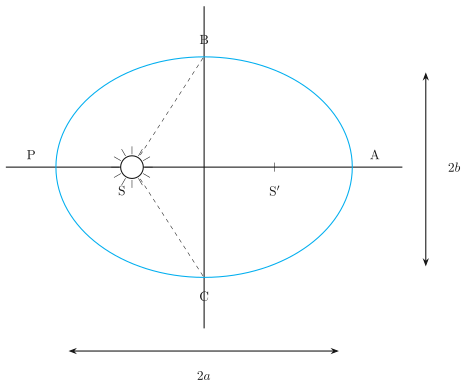
Q.Let the speed of the planet at the perihelion in Fig. 7.1(a) be and the Sun-planet distance be . Relate to the corresponding quantities at the aphelion . Will the planet take equal times to traverse and ?
You're viewing a preview — the full solution, concept, methods & PYQ mapping are locked.
Start your 14-day free trial to unlock the full solution →Conservation of angular momentum about the Sun gives , so the planet moves faster at perihelion ( since ). Because it moves faster near and slower near , the planet does NOT take equal times to traverse and , even though it sweeps equal areas in equal times.
Relating perihelion and aphelion
The Sun exerts a central force on the planet — gravity acts along the line joining the Sun and the planet — so the torque about the Sun is always zero, and the planet's angular momentum about the Sun is conserved throughout the orbit.
At perihelion , the planet is at distance and moves with speed , which is perpendicular to the radius . At aphelion , it is at distance with speed , again perpendicular to . Since the velocity is perpendicular to the radius at both extreme points, the angular momentum there is simply :
Conservation of angular momentum () gives
Since (aphelion is farther from the Sun), this forces — the planet moves fastest at perihelion and slowest at aphelion.
Will the times to traverse and be equal?
Suppose the major axis divides the ellipse into two halves: arc (the half containing aphelion ) and arc (the half containing perihelion ). By Kepler's second law, the radius vector from the Sun sweeps out equal areas in equal times — and since each half of the ellipse (split by the major axis) has exactly half the total area, a naive reading might suggest the two halves take equal time. …
Unlock everything free for 14 days
- Full step-by-step solutions
- Concept-first explanations
- Methods, shortcuts & mistakes
- PYQ mapping + timed mock tests
Full access for 14 days. No credit card required.