Physics · Ch 12 — Kinetic Theory
Pressure of an Ideal Gas
Pressure of an Ideal Gas
The Pressure of an Ideal Gas: A Molecular Derivation
The kinetic theory of gases aims to connect the macroscopic property we call pressure to the microscopic behaviour of molecules. Pressure, measured by a gauge on a gas cylinder, is actually the average result of countless tiny collisions between gas molecules and the container walls. The derivation that follows is one of the most important in the chapter — it shows how a purely mechanical picture of bouncing molecules leads directly to the ideal gas law.
The Physical Picture
Consider a cubical container of side length , containing identical molecules, each of mass . The molecules are in random, ceaseless motion. The key assumptions we make are those of the kinetic theory: the molecules are point particles (negligible size), they obey Newton's laws, collisions with the walls are perfectly elastic, and there are no intermolecular forces except during collisions.
Pressure arises because molecules strike the walls, reverse their momentum component perpendicular to the wall, and thus impart an impulse to the wall. The average force on any wall, divided by its area, gives the pressure.
The derivation treats motion in three independent directions. Because the gas is isotropic (no preferred direction), the same pressure acts on every wall. This isotropy is a consequence of the random motion of a large number of molecules.
Step 1: Momentum Change in a Single Collision
Take the wall perpendicular to the -axis. Consider a molecule with velocity components . When it strikes this wall, the -component of its velocity reverses from to , while and remain unchanged (the wall is smooth, so no tangential force acts).
The change in momentum of the molecule is:
By Newton's third law, the momentum imparted to the wall is per collision.
Step 2: Number of Collisions per Unit Time
Not every molecule hits the same wall at the same instant. We need the average rate at which a given molecule strikes a particular wall. A molecule with -velocity will travel a distance (to the opposite wall and back) between successive collisions with the same wall. The time between collisions with that wall is:
Therefore, the number of collisions this molecule makes with that wall per unit time is:
Step 3: Force from One Molecule
The average force exerted on the wall by this single molecule is the momentum transferred per collision multiplied by the collision rate:
This is the average force from one molecule. Notice that it depends on , not on — this is crucial because the sign of doesn't matter; molecules moving left or right both contribute positively to pressure.
Step 4: Total Force from All Molecules
The total force on the wall is the sum over all molecules:
We now define the mean square speed in the -direction:
So the total force becomes:
Step 5: Relating to the Total Mean Square Speed
For any molecule, the square of its speed is:
Averaging over all molecules:
Because the gas is isotropic, the average square of each velocity component must be the same:
Therefore:
This factor of is not an approximation — it follows directly from the isotropy of random motion. It appears in the final pressure formula and is the reason the kinetic theory gives the correct coefficient in the ideal gas law.
Step 6: Pressure on the Wall
Pressure is force per unit area. The area of the wall is , so:
But , the volume of the container. Substituting :
This is the fundamental result:
Step 7: Introducing the Root Mean Square Speed
The root mean square speed (rms speed) is defined as:
So the pressure can be written compactly as:
The rms speed is not the same as the average speed. For a Maxwellian distribution, , where is the mean speed. Always use in the pressure formula — using the average speed would give the wrong numerical factor.
Step 8: Connecting to the Ideal Gas Law
We know from experiment that for an ideal gas:
…
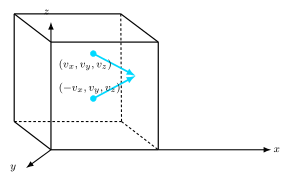
Drawn by us to help you understand the concept clearly, and verified to make sure it's accurate. For exams, practice from your textbook's own diagram.
The figure shows a single gas molecule inside a cubical container, drawn in oblique projection so you see three perpendicular edges labelled x, y, and z. The z-axis points upward, the y-axis goes into the page, and the x-axis points to the right. The left wall of the cube lies in the yz-plane — that is the wall the molecule is about to hit.
The molecule is drawn as a small sphere approaching that left wall. Its velocity just before impact is shown as an arrow with three components: , , . After striking the wall, the molecule rebounds with velocity . The two arrows — incoming and outgoing — form a clear V shape whose vertex lies exactly on the wall. The x-component of velocity reverses sign; the y- and z-components remain unchanged.
The key physical idea is that the collision with the wall is perfectly elastic and the wall is rigid and smooth. No kinetic energy is lost, and no force acts parallel to the wall — so only the component normal to the wall () flips direction.
From this single collision the textbook derives the pressure exerted by the gas. The molecule’s change in momentum during the collision is:
so the wall receives an impulse in the +x direction. The molecule then travels to the opposite wall, rebounds, and returns to the same wall after a round-trip time , where is the side length of the cube. The average force on this one wall from this one molecule is therefore:
Summing over all molecules and using the fact that the average of is one-third of the mean square speed (because the three directions are equivalent), the total force on the wall becomes:
Pressure is force per unit area, and the wall area is , so:
Here is the volume of the container, is the mass of one molecule, is the total number of molecules, and is the mean of the squared speeds of all molecules. This is the fundamental kinetic-theory relation linking the macroscopic pressure to the microscopic motion of molecules. …