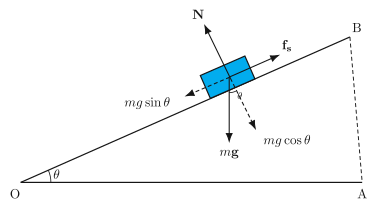
Q.A mass of rests on a horizontal plane. The plane is gradually inclined until at an angle with the horizontal, the mass just begins to slide. What is the coefficient of static friction between the block and the surface?
You're viewing a preview — the full solution, concept, methods & PYQ mapping are locked.
Start your 14-day free trial to unlock the full solution →When a block just begins to slide on an incline, static friction has reached its maximum value and exactly balances the component of weight down the slope; equating these gives .
Why the block stays put — until it doesn't
A block on an incline experiences two components of its weight: one pressing it into the surface (the normal component) and one trying to pull it down the slope (the tangential component). Static friction opposes the tangential pull, but it has a limit. The maximum static friction force is , where is the coefficient of static friction and is the normal force.
The phrase "just begins to slide" is the key: at exactly , static friction has reached its maximum possible value and can no longer hold the block. Any steeper and the block accelerates down; any shallower and it stays put. At this critical angle, the forces are perfectly balanced.
The mass of the block will cancel out in this problem — the critical angle depends only on the coefficient of friction, not on how heavy the object is.
Step-by-step force analysis
-
Resolve the weight into components.
The block has weight (though we'll see the mass cancels). On an incline at angle :
- Component perpendicular to the plane:
- Component parallel to the plane (down the slope):
-
Find the normal force.
Since there's no motion perpendicular to the surface, the normal force balances the perpendicular component:
- Write the condition for impending motion. At the instant the block just begins to slide, static friction is at its maximum: …
Unlock everything free for 14 days
- Full step-by-step solutions
- Concept-first explanations
- Methods, shortcuts & mistakes
- PYQ mapping + timed mock tests
Full access for 14 days. No credit card required.