Physics · Ch 11 — Thermodynamics
Thermodynamic State Variables and Equation of State
Thermodynamic State Variables and Equation of State
Thermodynamic State Variables
A thermodynamic system is described by certain measurable quantities called state variables. These are properties that depend only on the current state of the system, not on how it reached that state. Common examples include pressure (), volume (), temperature (), internal energy (), and mass ().
The state of a system is fully specified when all its state variables are known. However, for a simple system (like a fixed mass of gas in a cylinder), only two independent state variables are needed to determine the rest. This is because these variables are connected by a relationship called the equation of state.
State variables are path-independent — their change depends only on the initial and final states, not on the process. This is what distinguishes them from quantities like heat and work, which are path-dependent.
Equation of State
The equation of state is the mathematical relation connecting the state variables of a system. For a given system, it tells you how one variable changes when others are altered.
For an ideal gas, the equation of state is the well-known ideal gas law:
where:
- = pressure of the gas
- = volume of the gas
- = number of moles of the gas
- = universal gas constant ()
- = absolute temperature (in Kelvin)
This equation shows that for a fixed amount of gas ( constant), if you know any two of , , or , the third is determined.
Properties of State Variables
The textbook lists three key properties that state variables satisfy. Each is derived from the fact that state variables depend only on the state, not the path.
Property 1: The change in a state variable is path-independent
If a system goes from an initial state to a final state , the change in any state variable is:
This change depends only on the initial and final values, not on the specific path taken between them.
Proof:
By definition, a state variable has a unique value for every equilibrium state. If the system goes from state to state along path A, and then returns from to along path B, the net change around the closed loop must be zero:
This is because after returning to the initial state, must have its original value. Therefore:
Thus the change from to is the same regardless of path.
This property is what makes state variables useful — you can compute without knowing the process details.
Property 2: The differential of a state variable is an exact differential
If is a state variable, its infinitesimal change is an exact differential. This means there exists a function such that can be written as:
where and are independent state variables, and the mixed partial derivatives satisfy:
Proof:
Since is a function of state, it can be expressed as for two independent variables and . The total differential is:
Let and . By Clairaut's theorem (equality of mixed partials for well-behaved functions):
This condition is the test for exactness. For state variables, it always holds.
Heat () and work () are not state variables — their differentials (, ) are inexact. You cannot write as a function of state alone.
Property 3: State variables can be classified as intensive or extensive
State variables fall into two categories:
- Intensive variables: Independent of the size or mass of the system (e.g., pressure , temperature , density ).
- Extensive variables: Proportional to the size or mass of the system (e.g., volume , internal energy , mass ).
Proof of scaling behaviour: …
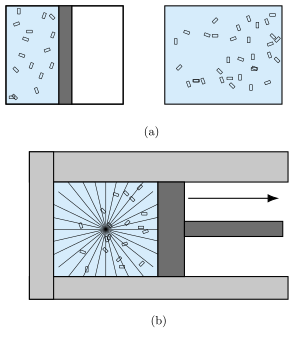
Drawn by us to help you understand the concept clearly, and verified to make sure it's accurate. For exams, practice from your textbook's own diagram.
Figure 11.6 in the NCERT textbook shows two situations where a system is not in thermodynamic equilibrium. The left panel (a) depicts a rigid container divided into two halves by a thick black partition. The left half contains a gas; the right half is a vacuum. An arrow leads to a second drawing of the same container, now with the partition removed — the gas has spread to fill the entire volume. This is free expansion: the gas rushes into the vacuum without doing any work and without exchanging heat with the surroundings. During the expansion itself, pressure and temperature are not uniform throughout the container; the gas is in a highly non-equilibrium state. Only after the gas settles (some time later) does it reach a new equilibrium.
The right panel (b) shows a grey cylinder with a piston on the right side. Inside the cylinder, a red centre with radiating explosion lines indicates an explosive chemical reaction. The explosion drives the piston outward. Here, the reaction is rapid and violent — the gas mixture burns, releasing heat and increasing pressure dramatically. Again, during the explosion, the gas is not in equilibrium: temperature, pressure, and composition vary wildly from point to point. The piston moves because the system is not balanced.
Both free expansion and an explosive reaction are irreversible processes. They proceed through non-equilibrium states. Thermodynamic state variables (pressure , volume , temperature ) are defined only for equilibrium states. You cannot write an equation of state like for the gas during the expansion or explosion — only for the initial and final equilibrium states.
The textbook uses these examples to motivate why we need the concept of thermodynamic state variables and an equation of state. For a system in equilibrium, any two intensive variables (like and ) determine the third (like ) through a relation such as the ideal gas law:
where is pressure, is volume, is the number of moles, is the universal gas constant (), and is absolute temperature. This equation holds only when the system is in thermal, mechanical, and chemical equilibrium — exactly the condition that is violated in both panels of Fig. 11.6. …