Physics · Ch 1 — Units and Measurement
The International System of Units
The International System of Units
The Need for a Universal System
Before the modern era, scientists in different countries used different systems of units. This created confusion when comparing experimental results across borders. Three older systems were in widespread use:
- CGS system: centimetre, gram, second
- FPS (British) system: foot, pound, second
- MKS system: metre, kilogram, second
The problem is obvious: a measurement of force in the CGS system (dyne) and one in the FPS system (poundal) are not directly comparable without messy conversion factors. What was needed was a single, coherent system that everyone could agree on.
The SI System
The internationally accepted system today is the Système International d'Unités (International System of Units), abbreviated as SI. It was developed by the Bureau International des Poids et Mesures (BIPM) and was originally established in 1971. The most recent major revision came from the General Conference on Weights and Measures in November 2018.
The SI system uses the decimal system, which makes conversions within the system straightforward. For example, converting from metres to kilometres simply means moving the decimal point — no awkward factors like 12 inches to a foot or 3 feet to a yard.
The Seven Base Units
The SI system defines seven base units, each corresponding to a fundamental physical quantity that cannot be expressed in terms of other quantities. These are shown in the table below.
| Base Quantity | Name | Symbol |
|---|---|---|
| Length | metre | m |
| Mass | kilogram | kg |
| Time | second | s |
| Electric current | ampere | A |
| Thermodynamic temperature | kelvin | K |
| Amount of substance | mole | mol |
| Luminous intensity | candela | cd |
Each of these units is now defined in terms of fixed numerical values of fundamental physical constants. This is a crucial shift from older definitions that relied on physical artefacts (like the standard metre bar or the standard kilogram cylinder). Constants of nature do not change, so definitions based on them are permanent and universally reproducible.
Definition of the Metre
The metre is defined by fixing the numerical value of the speed of light in vacuum, , to be when expressed in the unit . The second is itself defined in terms of the caesium frequency .
The metre is no longer a fraction of the Earth's meridian or the length of a platinum-iridium bar. It is now derived from the speed of light, a universal constant.
Definition of the Kilogram
The kilogram is defined by fixing the numerical value of the Planck constant to be when expressed in the unit , which is equivalent to . The metre and the second are themselves defined in terms of and .
The old "international prototype of the kilogram" — a cylinder of platinum-iridium alloy kept in France — is no longer the definition. That artefact's mass was slowly changing due to surface contamination and other effects. The new definition based on the Planck constant is immutable.
Definition of the Second
The second is defined by fixing the numerical value of the caesium frequency , which is the unperturbed ground-state hyperfine transition frequency of the caesium-133 atom, to be when expressed in the unit Hz, which is equivalent to .
Definition of the Ampere
The ampere is defined by fixing the numerical value of the elementary charge to be when expressed in the unit C, which is equivalent to . The second is defined in terms of .
Definition of the Kelvin
The kelvin is defined by fixing the numerical value of the Boltzmann constant to be when expressed in the unit , which is equivalent to . The kilogram, metre, and second are defined in terms of , , and .
Definition of the Mole
The mole is defined by fixing the numerical value of the Avogadro constant to be when expressed in the unit . This number is called the Avogadro number. One mole contains exactly this many elementary entities.
When using the mole, the elementary entities must be specified. These can be atoms, molecules, ions, electrons, or any other specified group of particles. Saying "one mole of oxygen" is ambiguous — it could mean one mole of oxygen atoms (O) or one mole of oxygen molecules (O).
Definition of the Candela
The candela is defined by fixing the numerical value of the luminous efficacy of monochromatic radiation of frequency Hz, , to be 683 when expressed in the unit , which is equivalent to or . The kilogram, metre, and second are defined in terms of , , and .
You are not expected to memorise the exact numerical values in these definitions. They are given to show the extraordinary precision with which modern measurements are made. What matters is understanding the principle: each base unit is now defined by fixing a fundamental constant.
Supplementary Units: Plane Angle and Solid Angle
In addition to the seven base units, the SI defines two supplementary quantities that are dimensionless but have named units.
Plane Angle
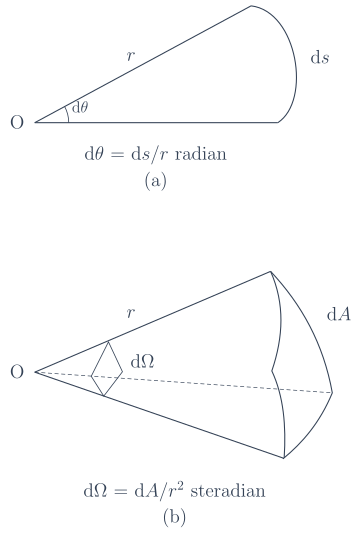
A plane angle is defined as the ratio of the length of an arc to the radius of the circle:
The unit of plane angle is the radian (symbol: rad). Since both and have the dimension of length, the ratio is dimensionless.
Solid Angle
A solid angle is defined as the ratio of the intercepted area on a spherical surface to the square of the radius :
The unit of solid angle is the steradian (symbol: sr). Again, since has dimensions of length squared and has dimensions of length squared, the ratio is dimensionless.
Both the radian and the steradian are dimensionless quantities. They are included in the SI system for convenience when dealing with angular measurements, but they do not add a new fundamental dimension.
Derived Units
All other physical quantities can be expressed in terms of the seven base units. These are called derived units. For example:
- Speed is length divided by time:
- Acceleration is speed divided by time:
- Force is mass times acceleration: , which is given the special name newton (N)
- Energy is force times distance: , which is given the special name joule (J)
- Power is energy per unit time: , which is given the special name watt (W)
A comprehensive list of derived units with special names is provided in the appendices of the textbook.
Units Outside the SI
Some units that are not part of the SI system are still retained for general use because of their widespread acceptance in specific contexts. These are listed in Table 1.2 of the textbook.
Table 1.2 — Some units retained for general use (though outside SI):
| Name | Symbol | Value in SI Unit |
|---|---|---|
| minute | min | 60 s |
| hour | h | 60 min = 3600 s |
| day | d | 24 h = 86400 s |
| year | y | 365.25 d = s |
| degree | ° | rad |
| litre | L | 1 dm = m |
| tonne | t | kg |
Drawn by us to help you understand the concept clearly, and verified to make sure it's accurate. For exams, practice from your textbook's own diagram.
Panel (a) shows the plane angle dθ subtended at a point O by a small arc of length ds on a circle of radius r centred at O: two straight lines (radii) go out from O, an angle dθ opens between them near the vertex, and the arc ds joins their far ends. By the geometric definition of angle in radian measure,
Panel (b) extends the same idea to three dimensions. From the apex O, a cone of rays goes out to a small patch of area dA on a sphere of radius r centred at O (the dashed line marks the cone's central axis, running from O to the far side of the patch). The solid angle dΩ is the small 3-D opening at O bounded by that cone, and is defined as the ratio of the intercepted area to the square of the radius:
…