Accountancy · Ch 7 — Issue and Redemption of Debentures
Redemption of Debentures
Redemption of Debentures
Redemption of Debentures
Redemption of debentures means the company repaying the amount it had borrowed from debentureholders. When a company redeems debentures, it extinguishes or discharges the liability that was created at the time of issue. The repayment must happen according to the terms mentioned in the debenture trust deed.
There are four methods by which a company can redeem its debentures, as shown below:
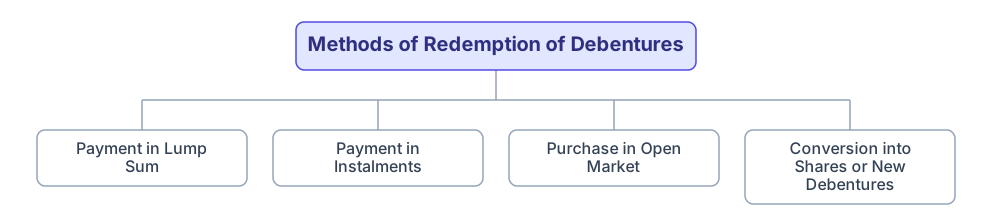
Payment in Lump Sum
Under this method, the company pays the entire amount due on the debentures in one single payment on the maturity date. All debentureholders receive their money at the same time, as per the terms of issue.
Payment in Instalments
Here, redemption happens in parts over several years during the tenure of the debentures. The total debenture liability is divided by the number of years to determine the amount to be redeemed each year. The company identifies which specific debentures are to be redeemed by drawing lots from the outstanding debentures. This method is also called redemption by draw of lots.
Purchase in the Open Market
When a company buys its own debentures from the open market with the intention of cancelling them, this act of purchasing and cancelling constitutes redemption. The company may buy these debentures at a price lower than their face value, which results in a profit for the company.
Conversion into Shares or New Debentures
A company can redeem its debentures by offering to convert them into shares or a new class of debentures. If the debentureholders find the offer beneficial, they can exercise their right to convert.
Key points regarding conversion:
- The new shares or debentures can be issued at par, at a discount, or at a premium.
- Only the actual proceeds received from the debentures at the time of their original issue are used to determine the number of shares to be issued in lieu of conversion.
- If debentures were originally issued at a discount, the actual amount realised (not the face value) is the basis for computing the number of shares to be issued.
- This method applies only to convertible debentures.
Factors to Consider at the Time of Redemption
1. Time of Redemption
Generally, debentures are redeemed on their due date. However, a company may redeem its debentures before the maturity date if its articles of association allow for such early redemption.
2. Sources of Redemption
A company can source the funds for redemption either out of capital or out of profits.
Exempted Companies: The following categories of companies are exempted from creating a Debenture Redemption Reserve (DRR) and may redeem debentures out of capital:
- All India financial institutions registered by the Reserve Bank of India
- Banking companies
- Non-Banking Financial Companies (NBFCs) registered with RBI
- Housing Finance companies registered with the National Housing Bank
- Companies listed on a stock exchange
Other Unlisted Companies: For all other unlisted companies, the adequacy of Debenture Redemption Reserve shall be at least 10% of the value of the outstanding debentures.
Debenture Redemption Investment (DRI): All companies are required to invest or deposit a sum on or before April 30th of each year. This amount shall not be less than 15% of the amount of debentures maturing during the year ending on March 31st of the next year. This investment must be made in any one or more of the following:
- Deposit with any scheduled bank, free from any charge or lien
- Securities of the Central Government or any State Government
- Securities mentioned in sub-clauses (a) to (d) and (ee) of section 20 of the Indian Trusts Act, 1982
- Bonds issued by any other company which is notified under sub-clause (f) of section 20 of the Indian Trusts Act, 1982
The amount invested or deposited shall not be used for any purpose other than for redemption of debentures maturing during the year.
Treatment of DRI over Multiple Years:
- If debentures are redeemed in lump sum, the company will invest 15% of the value of debentures.
- If debentures are to be redeemed in instalments over a period, the investment shall not be realised but carried forward to meet the requirement for the next redemption. It must be at least 15% of the value of the debentures to be redeemed in the next year.
- If the Debenture Redemption Investment is more or less than 15% of the value of debentures to be redeemed, the investment shall be realised to the extent it is excess, and further amount shall be invested to meet any shortfall.
Example: Kays Ltd.
Kays Ltd. has 10,000, 60% debentures to be redeemed as follows:
| Date of Redemption | Number of Debentures | Value of Debentures (₹) |
|---|---|---|
| January 31, 2017 | 2,000 | 2,00,000 |
| January 31, 2018 | 3,000 | 3,00,000 |
| January 31, 2019 | 3,000 | 3,00,000 |