Economics · Ch 5 — Government Budget and the Economy
Classification of Receipts
Classification of Receipts
Revenue Receipts
Revenue receipts are those inflows of money to the government that do not create a liability for the government, nor do they reduce its assets. In other words, the government does not have to repay this money, and it does not lose any future income by receiving it. These are therefore called non-redeemable receipts. They are divided into two broad categories: tax revenue and non-tax revenue.
Tax Revenue
Tax revenue is the most important component of revenue receipts. A tax is a compulsory payment made by individuals and firms to the government. There is no direct quid pro quo — the taxpayer does not receive a specific, equivalent benefit in return for the tax paid. Tax revenue is further classified into direct taxes and indirect taxes.
Direct taxes are those whose burden cannot be shifted to someone else. The person on whom the tax is levied is the one who ultimately bears it. The main examples are:
- Personal income tax: A tax on the income of individuals. This is designed to be progressive — the higher a person's income, the higher the tax rate they pay. This is a key tool for achieving the government's objective of reducing income inequality.
- Corporation tax: A tax on the profits of firms (companies). Unlike personal income tax, firms are taxed on a proportional basis — the tax rate is a fixed proportion of their profits, regardless of how large the profit is.
- Other direct taxes like wealth tax, gift tax, and estate duty (tax on inherited property) have historically brought in very little revenue. They are often referred to as 'paper taxes' because they generated more paperwork than actual revenue. Estate duty has since been abolished.
The distinction between direct and indirect taxes is crucial for understanding the government's ability to redistribute income. Direct taxes, especially progressive income tax, directly reduce the disposable income of the rich, while indirect taxes affect everyone who consumes the taxed good.
Indirect taxes are those whose burden can be shifted. The person who pays the tax to the government (e.g., a manufacturer) can pass it on to the final consumer by including it in the price of the good or service. The main examples are:
- Excise taxes: Duties levied on goods produced within the country.
- Customs duties: Taxes imposed on goods imported into India and, in some cases, exported out of India.
- Service tax: A tax on the provision of services.
The government uses the rate of excise tax to influence consumption patterns. Necessities of life are either exempted from excise tax or taxed at very low rates. Comforts and semi-luxuries are taxed moderately. Luxuries, tobacco products, and petroleum products are taxed very heavily.
Box 5.3 · GST: One Nation, One Tax, One Market. The Indian tax system was transformed by the Goods and Services Tax (GST), made operational on 1 July 2017. GST is a comprehensive, destination-based consumption tax levied on the supply of goods and services. Through an Input Tax Credit (ITC) mechanism, a business claims credit for the tax already paid on its inputs, so at each stage only the value added is effectively taxed — this removes the earlier cascading (tax-on-tax) effect.
Taxes it subsumed — at the Centre: Central Excise Duty, Service Tax, Central Sales Tax and various cesses; at the State level: State VAT/Sales Tax, Entry Tax, Luxury Tax, Octroi, Entertainment Tax, and taxes on advertisements, lotteries, betting and gambling. Kept outside GST for now: five petroleum products and alcoholic liquor for human consumption; tobacco attracts both GST and Central Excise.
Rate structure — there are essentially six standard rates: 0%, 3%, 5%, 12%, 18% and 28%, with necessities taxed low and luxuries/'sin' goods highest. GST rests on the 101st Constitution Amendment Act, 2016 (Article 246A cross-empowering Parliament and the State legislatures) and is levied through the CGST, SGST and UTGST Acts. It is administered on a common portal, and by widening the tax base and easing inter-state trade it was expected to add roughly 2% to GDP. It is implemented by the Centre, all 28 states and the Union Territories.
Non-Tax Revenue
Non-tax revenue consists of all revenue receipts that are not from taxes. The main sources for the central government are:
- Interest receipts: Interest earned on loans given by the central government to state governments, union territories, and other parties.
- Dividends and profits: The government's share of profits from its investments in public sector undertakings (PSUs) and other entities.
- Fees and other receipts: Charges for specific services rendered by the government, such as passport fees, court fees, or registration fees.
- Cash grants-in-aid: Grants received from foreign countries and international organisations.
The estimates of revenue receipts in the annual budget take into account the effects of any tax proposals made in the Finance Bill. The Finance Bill, presented alongside the Annual Financial Statement (the Budget), contains the legal details for imposing, abolishing, altering, or regulating taxes.
Capital Receipts
Capital receipts are those inflows of money that either create a liability for the government or reduce its financial assets. This is the opposite of revenue receipts.
- Creating a liability: When the government borrows money (takes a loan), it creates a liability because the loan must be repaid in the future, along with interest. Examples include loans from the public (through government securities), loans from the Reserve Bank of India (RBI), and loans from foreign governments.
- Reducing financial assets: When the government sells an asset it owns, its stock of financial assets decreases. The most prominent example is the sale of the government's shares in Public Sector Undertakings (PSUs), a process known as PSU disinvestment. When the government sells an asset, it loses the future stream of income (e.g., dividends) that asset would have generated.
Therefore, all receipts that create a liability or reduce financial assets are classified as capital receipts.
A common mistake is to think that all loans are capital receipts. While loans taken by the government are capital receipts, loan repayments received by the government (e.g., from states repaying a loan) are also capital receipts because they reduce the government's financial asset (the loan it was owed).
Capital receipts can be further divided into:
- Debt-creating capital receipts: These are receipts that create a liability. The most important example is borrowings (fresh loans).
- Non-debt creating capital receipts: These are receipts that reduce assets but do not create a liability. The most important example is disinvestment (sale of government assets). …
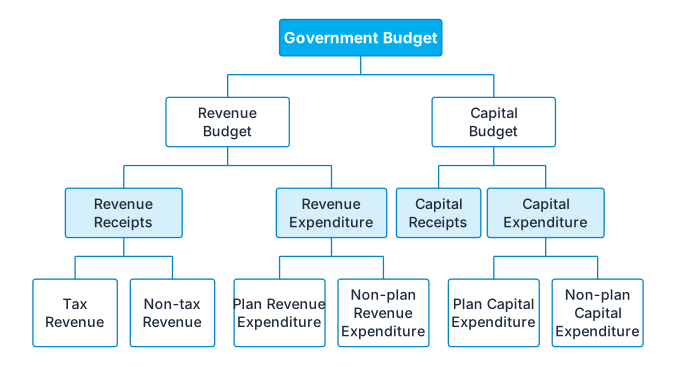
Drawn by us to help you understand the concept clearly, and verified to make sure it's accurate. For exams, practice from your textbook's own diagram.
Chart 1 summarises the whole structure of the government budget at a glance. The budget divides into a revenue budget and a capital budget: revenue receipts split into tax and non-tax revenue, while revenue expenditure and capital expenditure each split into plan and non-plan components. Notice that capital receipts are shown as a single …