Computer Science · Ch 10 — Computer Networks
Ring Topology
Ring Topology
In a ring topology, each node is connected to exactly two other devices — one on its left and one on its right. This creates a closed loop, or ring, of connected nodes. The key property of this arrangement is that the link is unidirectional: data travels in only one direction around the ring, either clockwise or counterclockwise.
Because data flows in a single direction, every node acts as a repeater. When a node receives a signal, it regenerates the signal and passes it along to the next node in the ring. This continues until the data reaches its intended destination.
The unidirectional nature of a ring topology means that if any single node or link in the ring fails, the entire network breaks — data cannot bypass the broken point. This is a major disadvantage compared to topologies like star or mesh.
Key characteristics of ring topology:
- Physical layout: Nodes are arranged in a circle, with each node connected to two neighbours.
- Data flow: Unidirectional — data travels in one direction only (clockwise or counterclockwise).
- Signal regeneration: Each node receives and retransmits the signal, so the signal does not degrade over long distances.
- Failure impact: A single node or link failure can bring down the entire network.
Advantages:
- Easy to install and reconfigure — adding or removing a node requires only breaking and rejoining the ring.
- No collisions occur because data flows in one direction and each node knows exactly when to transmit (using a token-passing protocol in many implementations).
- Performs well under heavy load compared to bus topology.
Disadvantages:
- A single break in the ring disables the entire network.
- Adding or removing a node temporarily disrupts the network.
- Troubleshooting is more difficult than in star topology because the problem could be anywhere in the ring. …
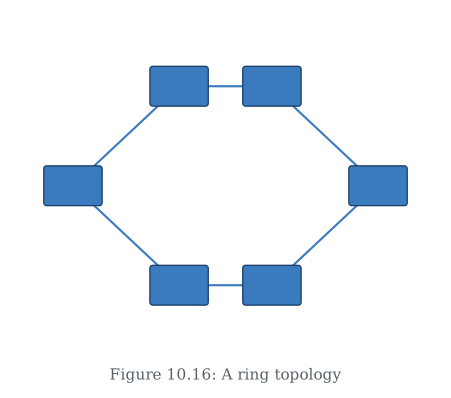
Drawn by us to help you understand the concept clearly, and verified to make sure it's accurate. For exams, practice from your textbook's own diagram.
In a ring topology, each node connects to exactly two neighbours — the one before it and the one after it — forming a closed loop with no central device. Data travels around the ring from node to node until it reaches its destination. …