Physical Education · Ch 1 — Management of Sporting Events
Procedure for Drawing Knock - Out Fixture
Procedure for Drawing Knock - Out Fixture
A knock-out (elimination) fixture is drawn in a fixed sequence of steps. Work through them in order.
Step 1 - Count the teams. First decide how many teams will take part. If the number is an exact power of two (2, 4, 8, 16, 32, 64, 128 ...), no byes are needed - see Illustrations 1 and 2. For any other number, byes must be given by draw of lot, as in Illustration 3.
Step 2 - Find the total number of matches.
Total number of matches = Number of teams - 1
So 8 teams play 8 - 1 = 7 matches, 12 teams play 12 - 1 = 11 matches, and 15 teams play 15 - 1 = 14 matches (a third-place play-off is not counted).
Step 3 - Divide the teams into an Upper Half and a Lower Half.
- If the number of teams is even: teams in each half = Number of teams / 2. For 12 teams, 12 / 2 = 6, so 6 teams go in the Upper Half and 6 in the Lower Half.
- If the number of teams is odd: Upper Half = (Number of teams + 1) / 2 and Lower Half = (Number of teams - 1) / 2. For 15 teams, Upper Half = (15 + 1) / 2 = 8 and Lower Half = (15 - 1) / 2 = 7.
Step 4 - Work out the byes. The number of byes is the difference between the number of teams and the next power of two above it.
Number of byes = Next power of two - Number of teams
For 12 teams the next power of two is 16, so 16 - 12 = 4 byes; being even, they split equally, 4 / 2 = 2 in each half. When the number of byes is odd, the split is:
Byes in Upper Half = (Number of byes - 1) / 2 and Byes in Lower Half = (Number of byes + 1) / 2
For 19 teams the next power of two is 32, giving 32 - 19 = 13 byes, split as (13 - 1) / 2 = 6 byes in the Upper Half and (13 + 1) / 2 = 7 byes in the Lower Half.
Step 5 - Fix the order in which byes are allotted. The first bye goes to the last team of the Lower Half, the second to the first team of the Upper Half, the third to the last team of the Upper Half, and the fourth to the first team of the Lower Half; the same cycle then repeats until all byes are placed. An alternative order is: first bye to the last team of the Lower Half, second to the first team of the Upper Half, third to the first team of the Lower Half, fourth to the last team of the Upper Half, and so on.
Step 6 - Draw the fixture. Write the serial numbers of the participants in a vertical column and split them into the two halves from Step 3. Place the byes as decided in Step 5, then fill in the remaining teams by random lottery from top to bottom. Teams holding a bye skip the first round. Finally, write the date, time and venue against each match.
The three worked illustrations below show the method for 4, 8 and 11 teams.
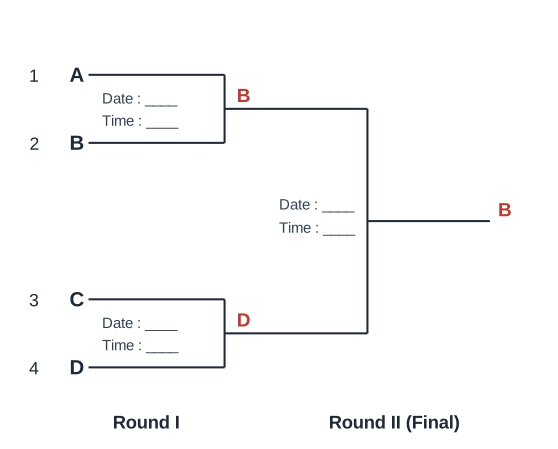
Illustration 1 - 4 teams
- Total number of teams = 4
- Total number of matches = 4 - 1 = 3
- Byes = none (4 is a power of two)
- Upper Half = 4 / 2 = 2 teams; Lower Half = 4 / 2 = 2 teams
Drawn by us to help you understand the concept clearly, and verified to make sure it's accurate. For exams, practice from your textbook's own diagram.
A single-elimination bracket for four teams at positions 1-4. Round I pairs A vs B (won by B) and C vs D (won by D); the Round II final pairs B vs D, won by B. Date and time blanks …
Round I: Match 1 - A vs B, won by B; Match 2 - C vs D, won by D.
Round II (Final): Match 3 - B vs D, won by B.
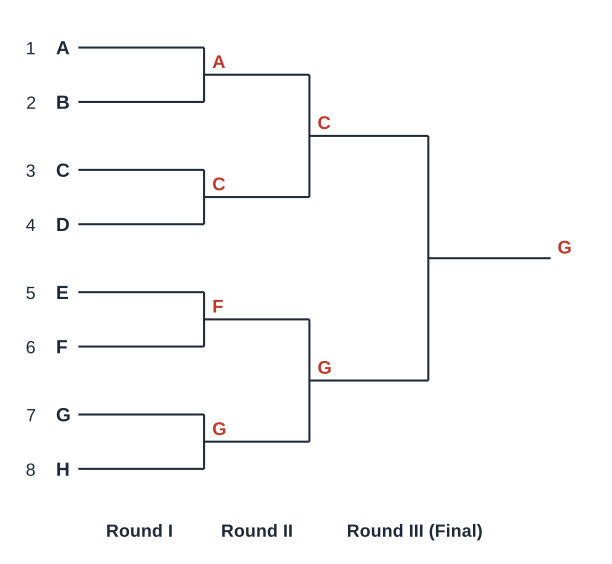
Illustration 2 - 8 teams
- Total number of teams = 8
- Total number of matches = 8 - 1 = 7
- Byes = none (8 is a power of two)
- Upper Half = 8 / 2 = 4 teams; Lower Half = 8 / 2 = 4 teams
Drawn by us to help you understand the concept clearly, and verified to make sure it's accurate. For exams, practice from your textbook's own diagram.
A single-elimination (knock-out) bracket for eight teams, A to H, placed at positions 1-8 with four teams in the upper half and four in the lower half. Because eight is a power of two, no byes are needed and 8 - 1 = 7 matches are played. Round I: A vs B (won by A), C vs D (won by C), E vs F (won by F), G vs H (won by G). Round II (semi-finals): A vs C (won by C) and F vs G (won by G). Round III (final): C vs G, won …
Round I: A vs B won by A; C vs D won by C; E vs F won by F; G vs H won by G.
Round II: A vs C won by C; F vs G won by G.
Round III (Final): C vs G won by G.
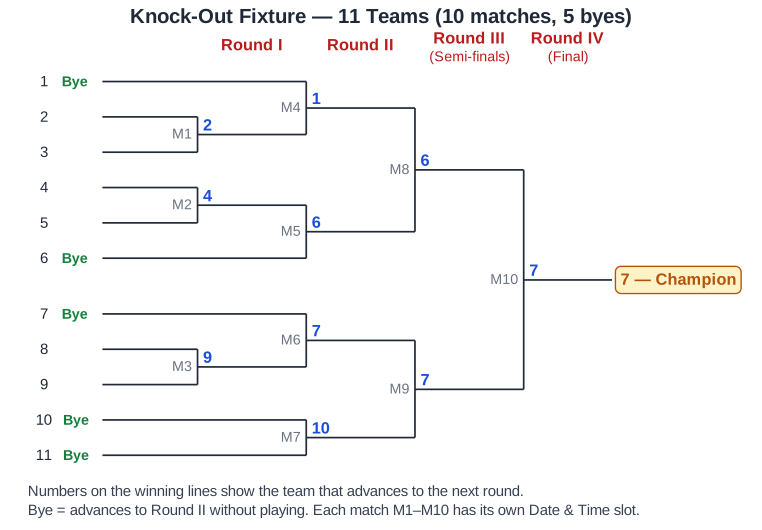
Illustration 3 - 11 teams
- Total number of teams = 11
- Total number of matches = 11 - 1 = 10
- Byes = 16 - 11 = 5 …
Drawn by us to help you understand the concept clearly, and verified to make sure it's accurate. For exams, practice from your textbook's own diagram.
A single-elimination bracket for eleven teams (positions 1-11). Five byes (B1-B5) are placed at positions 1, 6, 7, 10 and 11 - two in the upper half (positions 1-6) and three in the lower half (positions 7-11). Advancement lin …