Physical Education · Ch 7 — Physiology and Injuries in Sports
Effect of Exercise on Cardiovascular System
Effect of Exercise on Cardiovascular System
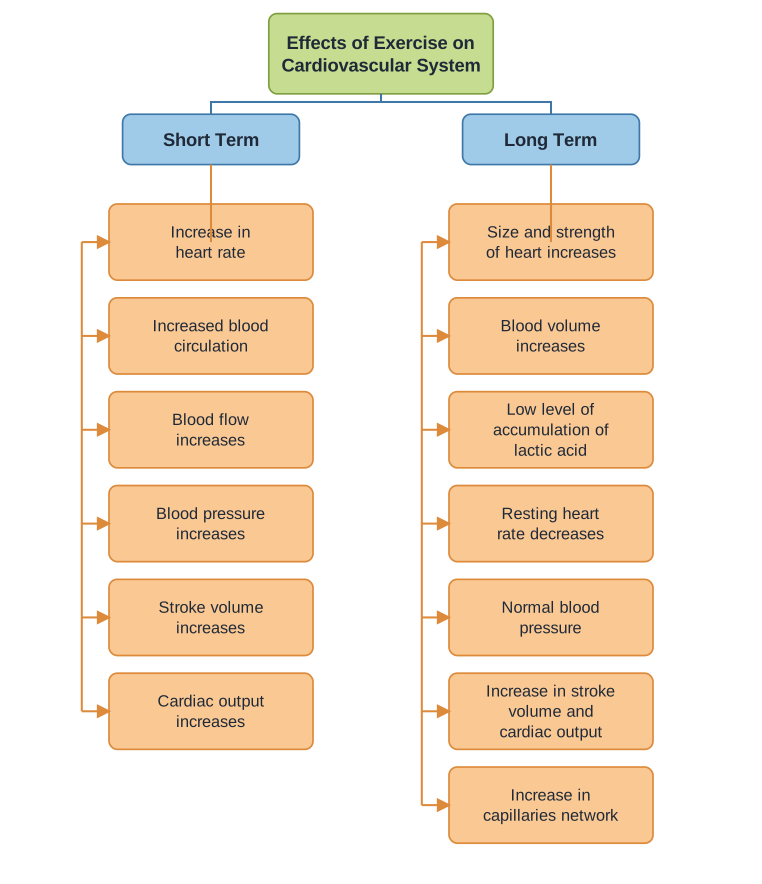
The effects of exercise on the cardiovascular system, like those on the muscles, can be divided into short-term and long-term effects.
Drawn by us to help you understand the concept clearly, and verified to make sure it's accurate. For exams, practice from your textbook's own diagram.
A flow diagram headed 'Effects of Exercise on Cardiovascular System' (green parent box) branching into two blue category boxes. 'Short Term' branches to six orange boxes: Increase in heart rate; Increased blood circulation; Blood flow increases; Blood pressure increases; Stroke volume increases; Cardiac output increases. 'Long Term' branches to seven orange boxes: Size and strength of heart increases; Blood volume increases; Low level of accumulation of lactic acid; Resting heart rate decreases; Normal blo …
Short-term effects of exercise on the cardiovascular system
- Increased heart rate — Exercise makes the body work harder, so the muscles need more oxygen. The heart meets this sudden demand by pumping faster, raising the heart rate.
- Increased blood circulation — As the heart rate rises, blood circulation increases to carry oxygen to the muscles, so the flow of blood to the tissues and organs goes up.
- Increased blood pressure — Endurance exercise raises systolic blood pressure in direct proportion to the intensity of the effort, driven by the rising cardiac output; with most training there is very little change in diastolic blood pressure.
- Increased stroke volume — Stroke volume is the volume of blood pumped in one contraction. During exercise it rises to deliver more oxygen, and after an endurance-training programme the heart's capacity to pump blood in a single beat can increase by 20 to 50 per cent.
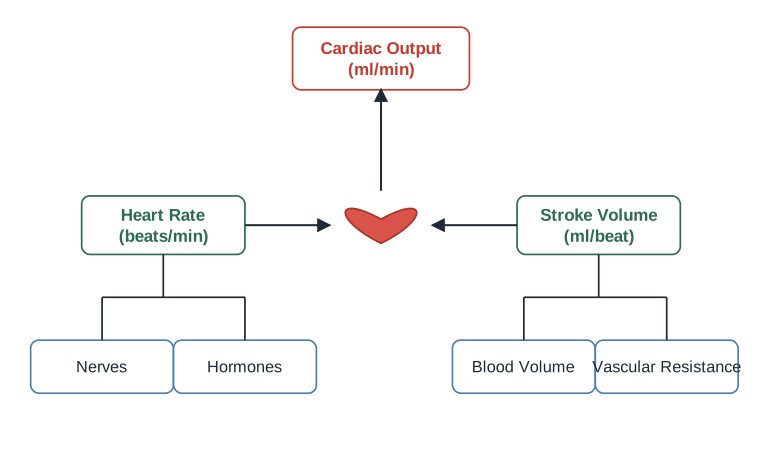
- Increased cardiac output — Cardiac output is the amount of blood pumped by each ventricle in one minute; it is the product of heart rate (HR) and stroke volume (SV). Resting cardiac output is about 5.0 L/min but varies with body size, while maximal cardiac output ranges from under 20 L/min in sedentary people to 40 or more L/min in elite endurance athletes. Because both heart rate and stroke volume rise during exercise, cardiac output rises too.
The determinants of cardiac output can be summarised in a single relationship, shown below.
Drawn by us to help you understand the concept clearly, and verified to make sure it's accurate. For exams, practice from your textbook's own diagram.
A determinants diagram centred on a simple heart symbol. Above the heart, an upward arrow leads to a box 'Cardiac Output (ml/min)'. To the left, a box 'Heart Rate (beats/min)' points into the heart and branches down to two boxes, 'Nerves' and 'Hormones'. To the right, a box 'Stroke Volume (ml/beat)' points into the heart and branches down to two boxes, 'Blood Volume' and 'Vascular Resistance'. It expresses the relationship Cardiac Output = Heart Rate x Stroke Volume. Drawn as …
Long-term effects of exercise on the cardiovascular system
- Increased size and strength of the heart — Continuous aerobic exercise strengthens and enlarges the heart, improving performance. This healthy enlargement is called cardiac hypertrophy.
- Low level of accumulation of lactic acid — Regular exercise trains the muscles to work with lower oxygen levels and improves the circulation that carries oxygen around the body, so less lactic acid — the waste product that makes muscles tired and painful — builds up.
- Decrease in resting heart rate — A more efficient heart needs fewer beats to meet the body's needs at rest, so the resting heart rate falls. This is known as bradycardia.
- Normal blood pressure — Endurance training can substantially reduce both systolic and diastolic blood pressure, helping to keep it in the normal range. …