Physical Education · Ch 7 — Physiology and Injuries in Sports
Soft Tissue Injuries
Soft Tissue Injuries
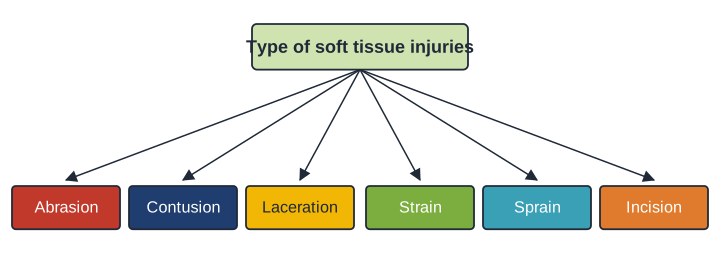
A soft tissue injury is damage to the muscles, ligaments and tendons anywhere in the body. The six soft tissue injuries named in the CBSE Class 12 Physical Education syllabus are shown below.
Drawn by us to help you understand the concept clearly, and verified to make sure it's accurate. For exams, practice from your textbook's own diagram.
A simple flow diagram. A parent box labelled 'Type of soft tissue injuries' connects, by short arrows, to a row of six coloured child boxes: Abrasion, Contusion, Laceratio …
Abrasion
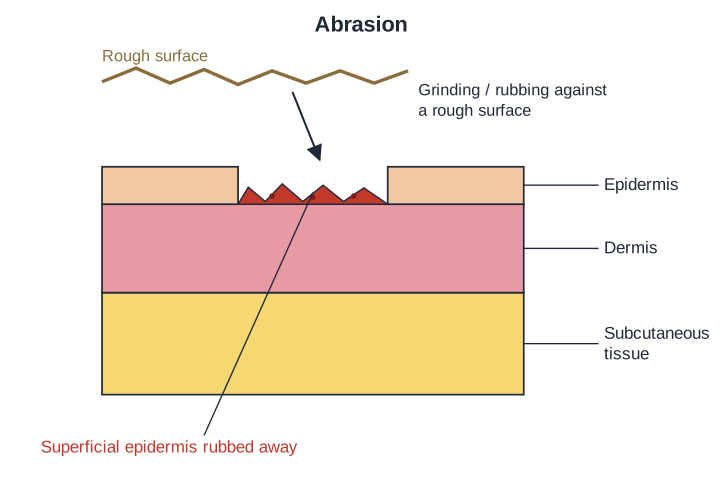
An abrasion most commonly occurs due to moving contact with a rough surface, which grinds or rubs away the upper superficial layers of the epidermis.
Drawn by us to help you understand the concept clearly, and verified to make sure it's accurate. For exams, practice from your textbook's own diagram.
A clean, own-drawn skin cross-section (not the textbook photograph). Three stacked, labelled layers — Epidermis, Dermis and Subcutaneous tissue. Over one region the top epidermal layers are scraped/rubbed away in an irregular grazed patch, labelled 'Superficial epidermis rubbed away', with a small arro …
- Cause — Abrasions happen when exposed skin meets a rough surface, grinding or rubbing away the upper layers of the epidermis (a graze from a fall on a track or court is a typical example).
- Treatment — Clean the surface of the affected part, stop the bleeding as early as possible using a compression bandage, and give an anti-tetanus injection.
Contusion
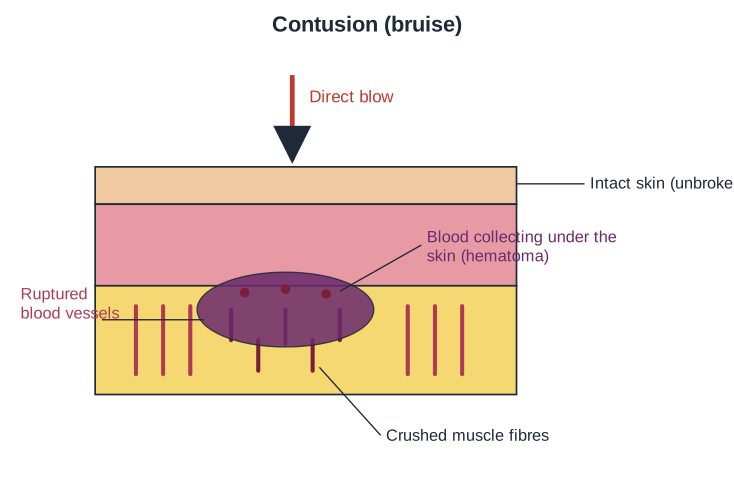
A contusion is a type of hematoma — a collection of blood outside a blood vessel.
Drawn by us to help you understand the concept clearly, and verified to make sure it's accurate. For exams, practice from your textbook's own diagram.
An own-drawn skin cross-section (not the textbook photograph). A downward force arrow labelled 'Direct blow' strikes intact, unbroken skin; beneath it the underlying muscle fibres are crushed and blood collects outside ruptured vessels. Labels: 'Intact skin (unbroken)', 'Ruptured blood vessels', 'Blood collect …
- Cause — When a part of the body is struck with enough force to crush the underlying muscle fibres and connective tissue without breaking the skin, a contusion occurs. It may follow a collision with another player or a piece of equipment, or a heavy fall.
- Prevention — Wear all the appropriate safety gear while playing, such as a helmet and guards.
- Treatment — Non-steroidal anti-inflammatory drugs such as ibuprofen, or other pain-relief medication as prescribed by a doctor.
Laceration
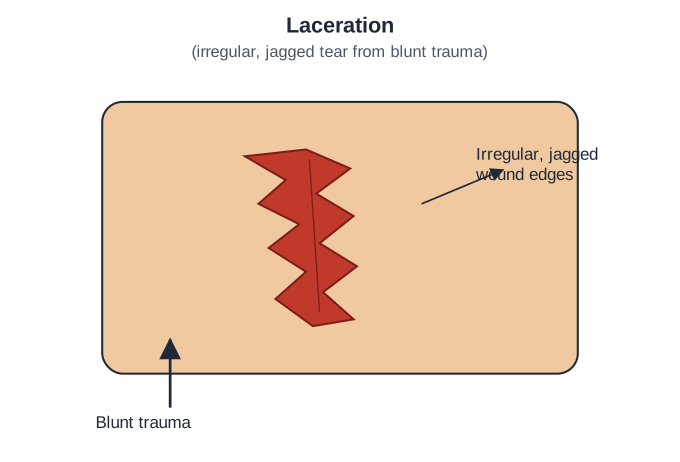
A laceration is an irregular, tear-like wound caused by some blunt trauma.
Drawn by us to help you understand the concept clearly, and verified to make sure it's accurate. For exams, practice from your textbook's own diagram.
An own-drawn view of the skin surface (not the textbook photograph). An open wound with irregular, ragged, uneven edges (deliberately contrasted with the clean straight edges of an incision), labelled 'Irregular, jagged wound edges …
- Cause — Usually the result of the skin striking an adjacent object, or an object striking the skin with force.
- Prevention — Proper personal equipment, including eye protection, can help prevent it.
- Treatment — Clean the surface of the affected part and stop the bleeding as early as possible using a compression bandage.
Strain
A strain is an injury to a muscle or a tendon, generally caused by overuse, force or stretching. Depending on its severity, a strain may be a simple overstretch of the muscle or tendon, or it may result in a partial or complete tear. It can be an acute or a chronic soft tissue injury — a twist, pull or tear of a muscle or tendon.
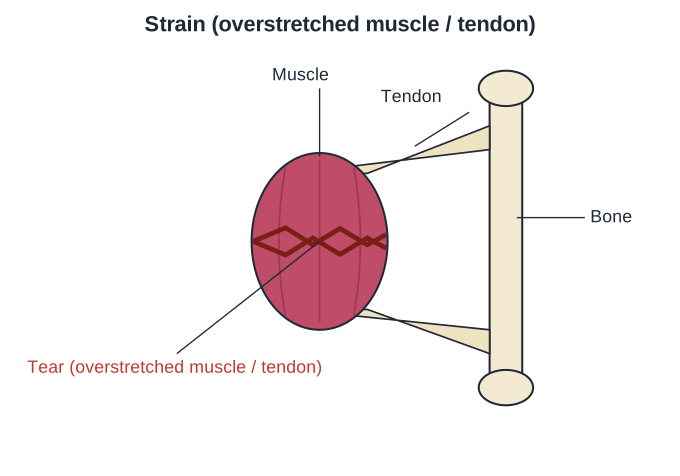
Drawn by us to help you understand the concept clearly, and verified to make sure it's accurate. For exams, practice from your textbook's own diagram.
An own-drawn anatomical schematic (not the textbook's third-party image). A skeletal muscle with its tendon attaching to a bone; the muscle belly shows a partial tear where it has been overstretched. Labels: 'Muscle', 'Tendon', 'Bone', …
- Cause — Strains occur suddenly (acute strain) or develop slowly over time (chronic strain). Common causes include lifting heavy objects, running, jumping and throwing.
- Prevention — Regular stretching and strengthening exercises suited to the sport.
- Treatment — Apply ice packs and keep the strained muscle in a stretched position — the RICE protocol: Rest, Ice, Compression and Elevation.
Sprain
A sprain is the stretching or tearing of a ligament, the fibrous tissue that connects bones at a joint. It happens when a joint is overextended or a ligament is torn while the joint is severely stressed. The most common site of a sprain is the ankle.
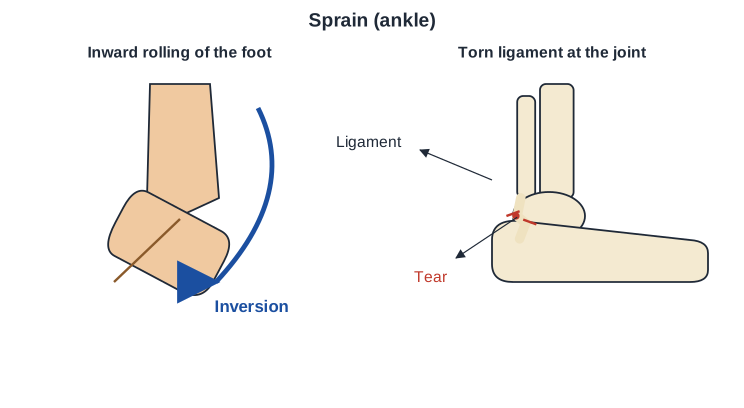
Drawn by us to help you understand the concept clearly, and verified to make sure it's accurate. For exams, practice from your textbook's own diagram.
An own-drawn two-panel anatomical schematic (not the textbook's third-party image). Left panel: a foot rolling inward with a curved arrow labelled 'Inversion'. Right panel: the ankle bones with a ligament stretched an …
- Cause — Overextending or tearing a ligament while severely straining a joint.
- Prevention — Regular stretching and strengthening exercises for the sport being played.
- Treatment — The RICE protocol: rest, ice, compression and elevation.
Incision …
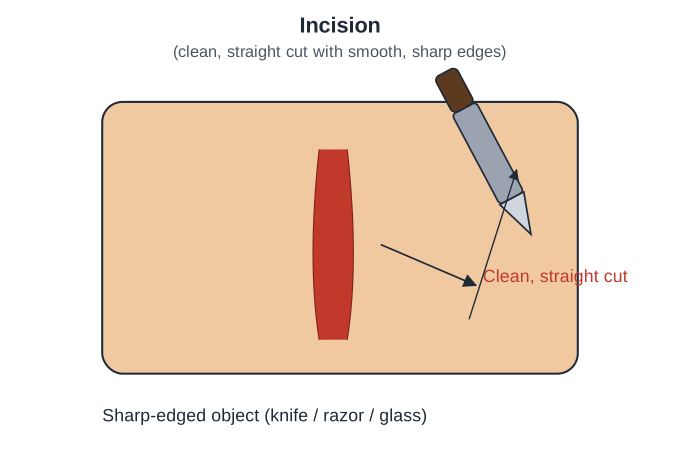
Drawn by us to help you understand the concept clearly, and verified to make sure it's accurate. For exams, practice from your textbook's own diagram.
An own-drawn view of the skin surface (not the textbook photograph). A clean, straight cut with smooth, sharp edges (contrasted with the ragged edges of a laceration), labelled 'Clean, straight cut', with a small sharp object and label 'S …