Physical Education · Ch 6 — Test and Measurement in Sports
Arm Curl Test
Arm Curl Test
Arm Curl Test
- Purpose: to determine upper body strength.
- Objective: to complete the maximum number of arm curls in 30 seconds.
- Equipment: a straight-back chair without arms; a dumbbell - 8 pounds (3.6 kg) for men and 5 pounds (2.3 kg) for women; and a stopwatch.
Procedure
The chair is placed where it stays stable. The individual sits with the back straight and feet flat on the floor, holding the dumbbell in the dominant hand with a handshake grip. On the command "Go" the person flexes the elbow, curling the arm through its full range of motion, then returns to the starting position, bringing the dumbbell back to the handshake grip in the down position. As many arm curls as possible are performed in 30 seconds.
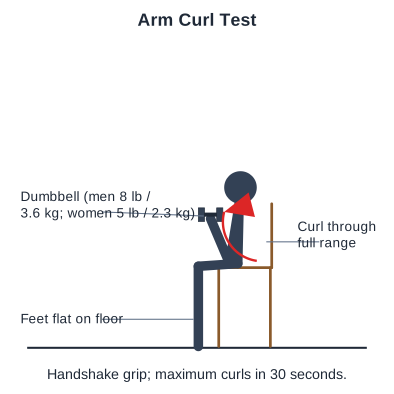
Drawn by us to help you understand the concept clearly, and verified to make sure it's accurate. For exams, practice from your textbook's own diagram.
A line drawing of an older adult seated upright on a straight-back armless chair, feet flat on the floor, holding a dumbbell in the dominant hand with a handshake grip. A curved arrow at the elbow shows the arm curling up through its full range of motion and b …
Scoring
The maximum number of correctly performed arm curls in 30 seconds is counted as the score.
Why It Matters (Physiological Rationale)
The arm curl isolates the biceps and forearm flexor muscles, which are responsible for lifting and carrying objects in daily life. The fixed dumbbell weights (8 lb for men, 5 lb for women) were chosen by Rikli and Jones to represent a realistic everyday carrying load, roughly the weight of a shopping bag or a small grandchild, rather than a maximal-strength load, so the test reflects functional, usable strength rather than a one-repetition maximum.
Benefits of Regular Testing
- Tracks upper-body strength endurance that supports everyday tasks such as carrying groceries, lifting a kettle, or picking up a small child.
- Loss of upper-body strength with age is linked to reduced independence; repeated testing shows whether a resistance programme is maintaining or improving it.
- Being seated and using a light, fixed weight keeps the test safe even for frailer participants.
Common Mistakes & Precautions
- Swinging the upper arm or using the shoulder and back to "cheat" the weight up, instead of curling strictly at the elbow; only a strict curl should be counted.
- Not returning the dumbbell fully to the down (handshake-grip) position before starting the next curl, which shortens the real range of motion.
- Selecting the wrong dumbbell weight for the participant's gender/category; the 8 lb and 5 lb weights are fixed by the protocol and should not be substituted.
- Continuing despite elbow or shoulder pain; mild muscular fatigue is expected, but joint pain means the test should stop. …