Physical Education · Ch 3 — Yoga as Preventive Measure for Lifestyle Disease
Halasana
Halasana
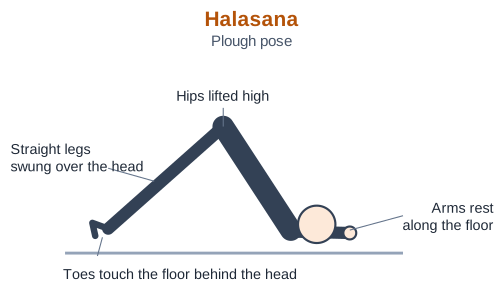
Hala means plough, and this posture is called Halasana because in its final position the shape of the body resembles the Indian plough. It is a supine inversion — you begin lying on the back and take the legs up and over the head. For obesity it is prescribed because folding the legs over the head compresses and stimulates the abdominal organs while decompressing the spine.
Drawn by us to help you understand the concept clearly, and verified to make sure it's accurate. For exams, practice from your textbook's own diagram.
Side view of the plough pose: the person lies on the back and brings both straight legs up and over the head until the toes rest on the floor behind the head, the hips lifted and the arms extended along the floor, the w …
Procedure
- Take a supine position, hands straight by the sides of the thighs, palms resting on the ground.
- Slowly raise the legs together to an angle of 30 degrees, without bending the knees, by pressing the hands down.
- After a few seconds, raise the legs further to 60 degrees and hold for a few seconds.
- Now slowly bring the legs to a 90-degree angle.
- Pressing with both hands, slowly bring the legs over towards the head.
- Continue until the toes touch the ground, then stretch the legs backward as far as possible.
- Place both palms on the head in a finger-lock and bring the elbows to the ground.
- To return, first release the finger-lock, stretch the hands straight and place them on the ground by the sides of the body.
- Lower the waist and bring the legs back, letting the waist rest on the ground and stopping the legs at a 90-degree angle.
- Slowly come back to the original position.
Breath awareness: keep the breath controlled and even. Raise the legs to 90 degrees on a deep inhalation and exhale completely; remain in the position for a few breaths to allow blood to flow.
Never turn the head to the side in Halasana — the neck is under load from the body's weight. Keep the chin tucked and the face looking straight up.
Benefits
For obesity, Halasana corrects digestive sluggishness and supports metabolic health:
- If there is a complaint of dyspepsia (indigestion) or constipation caused by disturbance of the abdominal muscles, it can be corrected by practising this asana. …