Biology · Ch 9 — Biotechnology: Principles and Processes
Isolation of the Genetic Material (DNA)
Isolation of the Genetic Material (DNA)
The Goal: Pure DNA
Before you can cut DNA with restriction enzymes, the DNA must be absolutely pure — free from every other type of molecule in the cell. This is the first practical step in any genetic engineering experiment.
Why Purity Matters
Restriction enzymes are precise molecular scissors. If the DNA sample is contaminated with proteins, RNA, or polysaccharides, those contaminants can physically block the enzyme from reaching its target sequence, or they can degrade the enzyme itself. The reaction simply won't work.
Step 1: Breaking the Cell Open
DNA is trapped inside cells, wrapped in membranes. To release it, you first need to break those barriers. The method depends on the type of cell:
- Bacterial cells — treated with lysozyme, an enzyme that digests the bacterial cell wall.
- Plant cells — treated with cellulase, which breaks down the cellulose cell wall.
- Fungal cells — treated with chitinase, which digests the chitin in fungal cell walls.
Once the cell wall is gone, the cell membrane is fragile and can be disrupted by gentle physical or chemical means, releasing the cell's contents — including DNA, RNA, proteins, polysaccharides, and lipids — into the solution.
Step 2: Removing Contaminants
The released mixture is a soup of macromolecules. You need to remove everything except DNA, one type at a time:
- RNA is removed by adding ribonuclease (an enzyme that specifically breaks down RNA).
- Proteins (including histones that DNA is wound around) are removed by adding protease (an enzyme that digests proteins).
- Other molecules (polysaccharides, lipids) are removed by appropriate chemical treatments — often using detergents or organic solvents that cause them to separate out.
Step 3: Precipitating the Pure DNA
After all contaminants are gone, the purified DNA remains dissolved in the aqueous solution. To collect it, you add chilled ethanol (cold alcohol). DNA is insoluble in alcohol, so it comes out of solution and forms a visible white, fibrous precipitate.
The textbook specifically mentions chilled ethanol — cold temperature helps the DNA precipitate more cleanly and prevents degradation by any remaining enzymes.
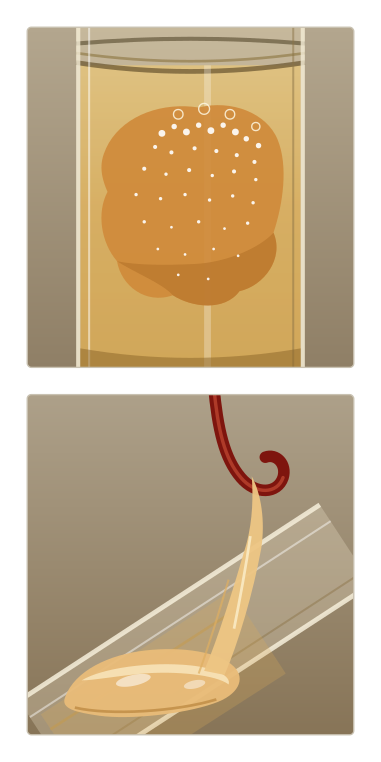
You can see this precipitate as a collection of fine threads in the suspension. These threads can be wound around a glass rod — a process called spooling — to physically lift the pure DNA out of the solution.
The Big Picture …
Drawn by us to help you understand the concept clearly, and verified to make sure it's accurate. For exams, practice from your textbook's own diagram.
The figure shows a simple laboratory scene: a glass beaker or test tube containing a clear liquid — the cell lysate after all the purification steps. Floating in that liquid, you see a mass of fine, white, thread-like strands. These are the precipitated DNA molecules. A glass stirring rod or a glass hook has been inserted into the tube, and the DNA threads are winding around it, being lifted out of the solution.
There are no panels, arrows, or labels in the figure itself — it is a single, straightforward illustration. The caption, "DNA that separates out can be removed by spooling", tells you exactly what is happening. The "spooling" refers to the action of winding the DNA fibres around the rod, much like winding thread onto a spool. …