Biology · Ch 6 — Evolution
What is Adaptive Radiation?
What is Adaptive Radiation?
Adaptive radiation is the process by which a single ancestral species evolves into a diverse array of descendant species, each adapted to a different ecological niche. The key idea is that one original form gives rise to many different forms, each suited to a particular way of life.
The textbook explains this concept through two classic examples.
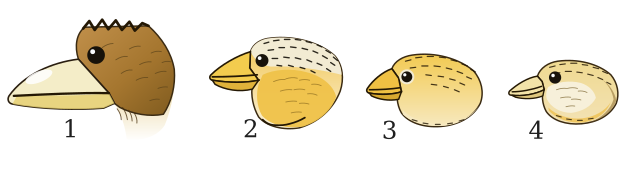
Darwin’s finches of the Galápagos Islands are the most famous case. Charles Darwin observed that the finches on these isolated islands had all descended from a single seed-eating ancestor that had arrived from the mainland. Over time, different populations of finches became isolated on different islands, each with its own set of food resources. Natural selection favoured different beak shapes and sizes depending on the available food — some finches developed large, strong beaks for cracking hard seeds, others evolved slender beaks for picking insects, and still others developed beaks suited for eating cactus flowers or fruits. What started as one species of finch eventually radiated into many species, each occupying a distinct feeding niche.
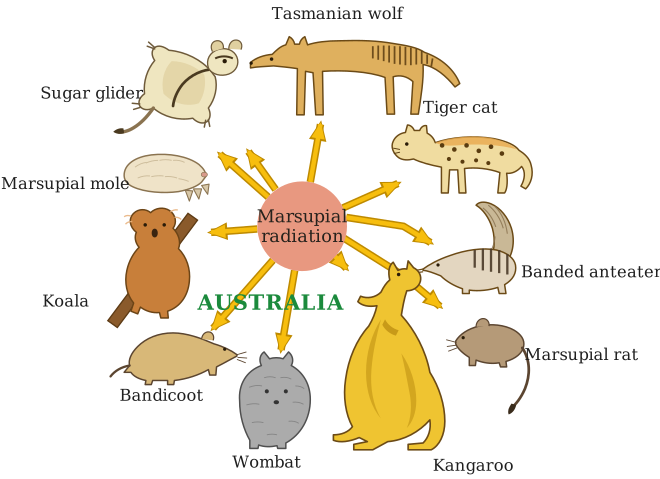
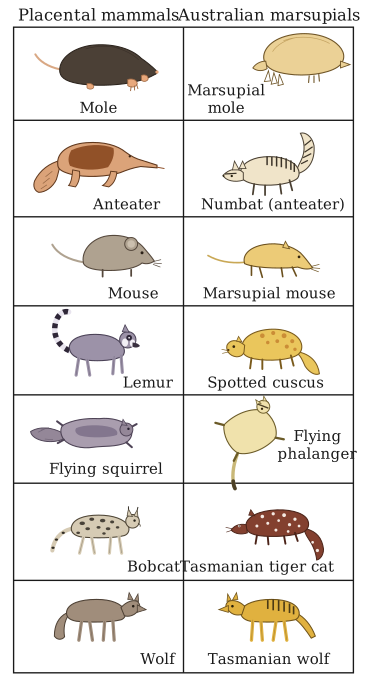
Australian marsupials provide another striking example. When Australia became isolated from other continents, its marsupial mammals diversified to fill the same ecological roles that placental mammals fill elsewhere. There are marsupial equivalents of wolves (the Tasmanian tiger, now extinct), cats (the quoll), moles (the marsupial mole), flying squirrels (the sugar glider), and even a marsupial 'mouse'. Each of these marsupials evolved from a common marsupial ancestor, but they adapted to different habitats and lifestyles — burrowing, gliding, hunting, and so on. This parallel evolution of similar body forms in marsupials and placentals is a powerful illustration of adaptive radiation driven by the same ecological opportunities. …
Drawn by us to help you understand the concept clearly, and verified to make sure it's accurate. For exams, practice from your textbook's own diagram.
The figure shows four finch head-and-beak profiles side by side, labelled simply 1, 2, 3, 4 — the book does not name individual species or diets here.
Each beak is a different shape: some short and deep (suited to crushing hard seeds), some long and thin (suited to probing for insects), reflecting how Darwin's finches on the Galapagos Islands diverged from a single common ancestor as different populations adapted to different food sources on different islands. …
Drawn by us to help you understand the concept clearly, and verified to make sure it's accurate. For exams, practice from your textbook's own diagram.
The figure is a radiating diagram — arrows fan outward from a central circle labelled "Marsupial radiation", with the word "AUSTRALIA" printed beside it in bold green, naming the isolated continent where this radiation took place.
From that centre, yellow/orange arrows radiate outward to a ring of individually illustrated marsupials, each labelled by its own name: Tasmanian wolf, Tiger cat, Banded anteater, Marsupial rat, Kangaroo, Wombat, Bandicoot, Koala, Marsupial mole, and Sugar glider. Each animal is drawn in a style suited to its own ecological role — the marsupial mole built for burrowing, the sugar glider for gliding between trees, the kangaroo for hopping across open ground — but the diagram itself shows only the radiating arrows and the animal illustrations, with no separate burrows, trees, or grassland backgrounds drawn in.
The figure is deliberately not a phylogenetic tree showing exact evolutionary relationships (which species branched off first). It is a conceptual diagram of adaptive radiation — the process, not the precise genealogy. …
Drawn by us to help you understand the concept clearly, and verified to make sure it's accurate. For exams, practice from your textbook's own diagram.
Figure 6.7 places two animals side by side in each of several pairs. On the left side of each pair is a marsupial from Australia; on the right side is a placental mammal from another continent (often Eurasia or the Americas). The pairs are arranged so that the two animals in each pair look strikingly similar in body shape, size, and overall appearance — even though they are not closely related.
The most famous pair in the figure is the Tasmanian wolf (also called the thylacine, a marsupial) next to the placental wolf (the grey wolf of Eurasia and North America). Both have a dog-like head, a lean body, and a long tail. Another pair shows a marsupial mole (which burrows in Australian soil) beside a placental mole (which burrows in European soil) — both have a cylindrical body, tiny eyes, and large shovel-like front claws. A third pair typically shows a marsupial mouse (an Australian native) next to a placental mouse (the common house mouse), both small, long-tailed rodents. There may also be a marsupial flying phalanger (a gliding possum) beside a placental flying squirrel — both have a flap of skin between forelimbs and hindlimbs for gliding.
No arrows or connecting lines are drawn between the pairs; the visual comparison itself is the point. The layout is simply a grid or a series of side-by-side portraits, with each marsupial on the left and its placental counterpart on the right. The caption labels each animal by its common name and its marsupial or placental status.
The figure does not show any geographic map, timeline, or phylogenetic tree. It only shows the animals themselves, arranged for direct visual comparison. …