Biology · Ch 8 — Microbes in Human Welfare
Microbes in Industrial Products
Microbes in Industrial Products
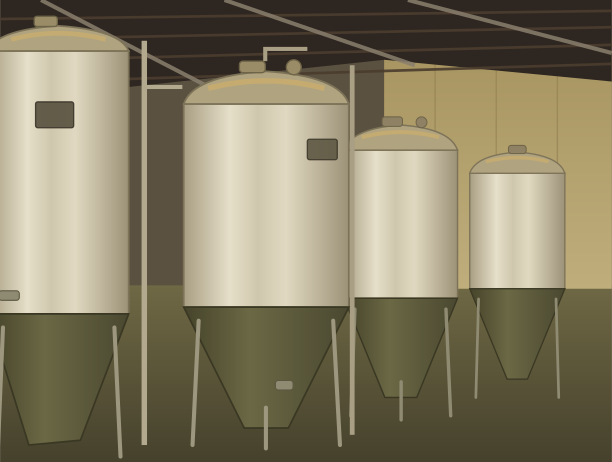
Even in industry, microbes are put to work on a large scale to make products valuable to us — beverages and antibiotics are the two biggest examples, alongside a range of chemicals, enzymes, and other bioactive molecules. Making anything at this scale means growing the chosen microbe in a very large vessel called a fermentor (Figure 8.4), under carefully controlled nutrient, temperature, and pH conditions, so that it yields as much of the desired product as possible. Once the microbe has done its work, the product is extracted and purified. …
Drawn by us to help you understand the concept clearly, and verified to make sure it's accurate. For exams, practice from your textbook's own diagram.
The real NCERT photograph for Figure 8.4 shows the outside of an industrial fermentation setup: three large cylindrical, conical-bottomed steel tanks standing on legs inside a shed, connected by overhead pipework. It is a plain photograph, not a labelled cutaway diagram -- there are no interior parts, arrows, or annotations printed on the image itself.
A fermentor (or bioreactor) is simply the large vessel in which microbes are grown at industrial scale to manufacture a valuable product -- an antibiotic, an enzyme, an organic acid, or a fermented beverage. Compared to a small flask in a lab, a fermentor lets a producer control the growing conditions (nutrients, oxygen supply, temperature, mixing) for a much larger volume of culture at once, which is what makes production on an industrial scale possible. …