Biology · Ch 4 — Principles of Inheritance and Variation
Inheritance of Two Genes
Inheritance of Two Genes
Inheritance of two genes is simply the study of how two different traits are passed from parents to offspring at the same time. When you look at a pea plant, you might notice both its seed shape (round or wrinkled) and its seed colour (yellow or green). The real question is: does the inheritance of seed shape affect the inheritance of seed colour? Or do these two traits behave independently? The answer, as Mendel discovered, is that they assort independently — but only if the genes for these traits are located on different chromosomes.
Mendel took this step after finishing his work on single traits. He crossed pea plants that differed in two characters: seed shape and seed colour. A true-breeding plant with round, yellow seeds (RRYY) was crossed with a true-breeding plant with wrinkled, green seeds (rryy). The F1 generation all had round, yellow seeds — confirming that round is dominant over wrinkled, and yellow is dominant over green. So far, nothing surprising.
The critical experiment was the F2 generation. Mendel self-pollinated the F1 plants (RrYy) and counted the offspring. He got four distinct types of seeds in the F2: round yellow, round green, wrinkled yellow, and wrinkled green. The numbers were striking — approximately 9 round yellow, 3 round green, 3 wrinkled yellow, and 1 wrinkled green. That 9:3:3:1 ratio is the classic signature of independent assortment.
Why does this ratio appear? Because when the F1 plant forms gametes, the alleles for seed shape (R and r) separate independently from the alleles for seed colour (Y and y). So a plant with genotype RrYy produces four types of gametes in equal proportions: RY, Ry, rY, and ry. When these gametes combine randomly during fertilisation, the 9:3:3:1 ratio emerges. This is the law of independent assortment: alleles of different genes segregate independently of each other during gamete formation. …
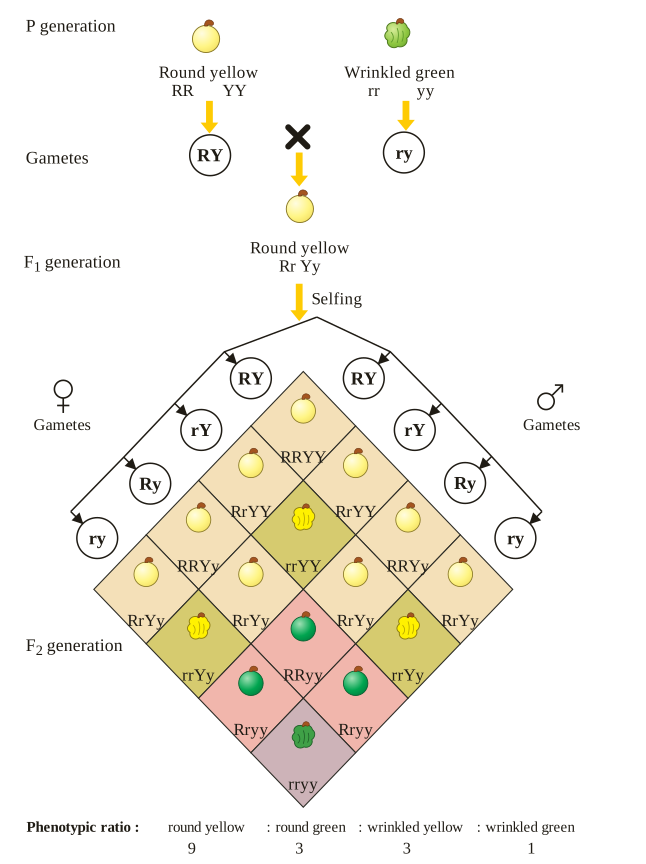
Drawn by us to help you understand the concept clearly, and verified to make sure it's accurate. For exams, practice from your textbook's own diagram.
Figure 4.7 is a classic Punnett square diagram that lays out the entire F₂ generation of a dihybrid cross. The two parents are pure-breeding lines: one with round, yellow seeds (genotype RRYY) and the other with wrinkled, green seeds (genotype rryy). The F₁ hybrid from this cross is RrYy, and it shows the dominant traits — round and yellow — because R is dominant over r, and Y is dominant over y.
The diagram is a 4 × 4 grid. Along the top row and the left column, the four possible gamete types from the F₁ parent are listed: RY, Ry, rY, and ry. Each gamete gets one allele for seed shape and one for seed colour, and because the two genes assort independently, all four combinations are equally likely.
Inside the 16 boxes of the grid, the genotypes from the fusion of male and female gametes are written. For example, the top-left box shows RRYY (from RY × RY), and the bottom-right box shows rryy (from ry × ry). Every box also carries a label for the corresponding phenotype: round-yellow, round-green, wrinkled-yellow, or wrinkled-green. …