Q.Write structures of the following compounds:
You're viewing a preview — the full solution, concept, methods & PYQ mapping are locked.
Start your 14-day free trial to unlock the full solution →The key idea is to interpret the IUPAC name as a structural blueprint: identify the parent chain, number the substituents, and place each group at the correct carbon. The final structures are drawn as line‑bond or condensed formulas for each compound.
Why this approach works
IUPAC nomenclature is a systematic code. Every part of the name tells you exactly where to put atoms and bonds.
- The parent name (pentane, cyclohexane, heptane, butene, benzene) gives the longest carbon chain or the ring.
- Prefixes (chloro, methyl, ethyl, etc.) are substituents attached at the numbered positions.
- Suffixes (-ane, -ene, -ol, etc.) tell you about unsaturation or functional groups.
- Stereodescriptors (like tert., sec.) describe the branching of the substituent itself.
If you misread the parent chain or the locant numbers, the structure will be wrong. So we go step by step.
1. 2‑Chloro‑3‑methylpentane
Parent chain: pentane → 5‑carbon straight chain.
Substituents:
- Chloro at carbon 2
- Methyl at carbon 3
Number the pentane chain from the end that gives the lowest locants to the substituents. Here, both 2 and 3 are already the smallest possible.
   Cl
    |
CH3-CH-CH-CH2-CH3
      |
     CH3
Condensed:
Always check that the parent chain is the longest continuous carbon chain. In this case, “pentane” is unambiguous.
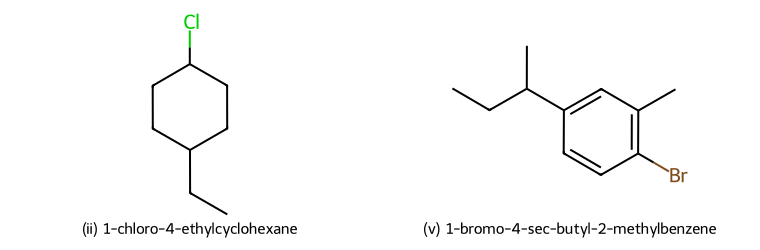
2. 1‑Chloro‑4‑ethylcyclohexane
Parent: cyclohexane (6‑carbon ring).
Substituents:
- Chloro at position 1
- Ethyl at position 4
Number the ring so that the substituents get the lowest possible numbers. Here, 1 and 4 are the smallest set (ring structure shown in the diagram above).
The ethyl group is a straight chain of two carbons attached to the ring.
A common mistake is to draw the ethyl group as a methyl group. Count carbons: ethyl = , not .
3. 4‑tert.‑Butyl‑3‑iodoheptane
Parent: heptane → 7‑carbon straight chain.
Substituents:
- Iodo at carbon 3
- tert.‑Butyl at carbon 4
The tert.‑butyl group is — a central carbon bonded to three methyl groups.
Number the heptane chain from the end that gives the lower locant to the first substituent (iodo at 3, tert.‑butyl at 4).
        I
        |
CH3-CH2-CH-CH-CH2-CH2-CH3
          |
          C(CH3)3
Condensed:
The tert.‑butyl group is bulky and often drawn as a branched substituent. Do not confuse it with sec.‑butyl or iso‑butyl.
4. 1,4‑Dibromobut‑2‑ene
Parent: but‑2‑ene → 4‑carbon chain with a double bond between carbons 2 and 3.
Substituents:
- Bromo at carbon 1
- Bromo at carbon 4
Number the chain so that the double bond gets the lowest possible number (it is already at 2). The bromines go at the ends.
Unlock everything free for 14 days
- Full step-by-step solutions
- Concept-first explanations
- Methods, shortcuts & mistakes
- PYQ mapping + timed mock tests
Full access for 14 days. No credit card required.