Chemistry · Ch 4 — The d- and f-Block Elements
General Characteristics
General Characteristics
Physical Properties
All the lanthanoids are silvery-white, soft metals, and they tarnish quickly on exposure to air. Softness is not uniform across the series, though — hardness increases with increasing atomic number, and by the time the series reaches samarium the metal is steel-hard.
Melting points mostly fall in a fairly narrow band, roughly –, but samarium again stands out as an exception, melting at the much higher . Structurally, the lanthanoids are typical metals and are good conductors of both heat and electricity. Density and most other physical properties change smoothly from one element to the next across the series, with europium and ytterbium as the main exceptions, and samarium and thulium occasionally behaving irregularly as well.
Colour and Magnetism of the Ions
Many trivalent lanthanoid ions are coloured, both as solids and in aqueous solution, and this colour is attributed to the presence of electrons. The two ions with no partially filled subshell — (which is ) and (which is ) — show no colour at all; every other ion in the series does. The absorption bands responsible for the colour tend to be narrow, which is put down to the fact that the electronic excitation is happening within the shielded level rather than at the outer surface of the ion.
The same / divide governs magnetism: every lanthanoid ion other than the type ( and ) and the type ( and ) is paramagnetic, since an or ion has no unpaired electrons left to respond to a magnetic field.
Ionisation Enthalpies
The first ionisation enthalpies of the lanthanoids sit around , and the second around — both broadly comparable to the values seen for calcium. Looking closely at how the third ionisation enthalpy varies along the series shows the same exchange-enthalpy effect already familiar from the transition series: certain occupancies (empty, half-filled, completely filled) carry extra stability. This shows up as an abnormally low third ionisation enthalpy exactly at lanthanum, gadolinium, and lutetium — the three points in the series where losing a third electron leaves behind an especially stable , , or ion.
Chemical Reactivity
The lanthanoids' chemical character shifts gradually across the series. The earlier members behave reactively, in a manner fairly close to calcium, while with increasing atomic number the later members start to behave more like aluminium.
The standard electrode potentials for the reduction half-reaction
fall in a narrow band of to for almost the whole series, with europium as the one outlier at — only a small variation overall, consistent with how similar these metals are to one another.
The lanthanoid metals react in a range of characteristic ways:
- They combine with hydrogen on gentle heating in the gas.
- Heated with carbon, they form carbides of formula , , and .
- They liberate hydrogen from dilute acids.
- They burn in halogens to give the trihalides, .
- They form oxides, , and hydroxides, — the hydroxides are genuine, definite compounds rather than simply hydrated oxides, and they are basic in character, much like the oxides and hydroxides of the alkaline earth metals.
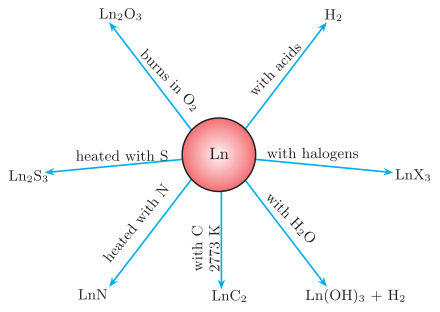
Drawn by us to help you understand the concept clearly, and verified to make sure it's accurate. For exams, practice from your textbook's own diagram.
What the Figure Shows
The figure is a radial reaction map — a central circle labelled Ln (representing any lanthanoid metal) with arrows radiating outward to the products formed under different conditions. Each arrow is labelled with the reagent and, where needed, the reaction conditions. The map summarises the general chemical behaviour of lanthanoid metals, showing that they are highly reactive and form a consistent set of compounds.
Physical Idea Taught
The core idea is that all lanthanoid metals undergo the same types of reactions, producing compounds in which the lanthanoid is almost always in the +3 oxidation state. This uniformity arises because the 4f electrons are deeply buried and do not participate in bonding — the outer and one electron (or a promoted 4f electron) are lost to give the stable ion. The figure therefore illustrates the predictable, homologous chemistry of the lanthanoid series.
Key Reactions and Their Products
- With oxygen (burns in ):
The product is the sesquioxide, .
- With halogens ():
Trihalides are formed (e.g., , ).
- With dilute acids:
Hydrogen gas is liberated.
- With water:
The metal reacts slowly with cold water, faster with hot water, to give the hydroxide and hydrogen.
- With carbon (at 2773 K):
Dicarbides are formed at very high temperature.
- With nitrogen:
Nitrides are produced on heating.
- With sulphur:
Sesquisulphides are formed.
Why This Matters for Exams
The figure is a visual summary of the lanthanoids’ reactivity pattern. In exam questions, you may be asked to: …
…