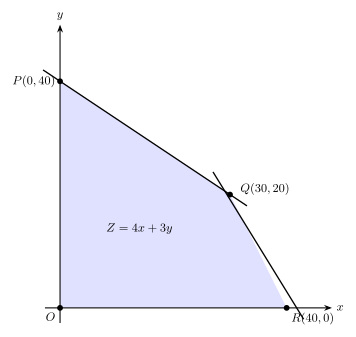
Q.For the linear programming problem (LPP), the objective function is and the feasible region determined by a set of constraints is shown in the graph: (Note: The figure is not to scale.) Which of the following statements is true?
(A) Maximum value of is at .
(B) Maximum value of is at .
(C) Value of at is less than the value at .
(D) The value of at is less than the value at .
You're viewing a preview — the full solution, concept, methods & PYQ mapping are locked.
Start your 14-day free trial to unlock the full solution →The Corner Point Theorem says the optimum of a linear objective over a convex polygon occurs at a vertex. Evaluating at the three corner points gives , , , so the maximum is at and option (B) is correct.
The Corner Point Theorem (also called the Fundamental Theorem of Linear Programming) is the key idea here. It states that if a linear programming problem has an optimal solution and the feasible region is a bounded convex polygon, then the optimum occurs at one of the vertices (corner points) of that region. This saves us from checking every single point inside the region — we only need to evaluate the objective function at the corners.
In the given graph, the feasible region is a triangle with vertices , , and . Let’s evaluate at each.
-
At :
-
At :
-
At :
Now compare the values: , , . The largest is at . So the maximum value of is at . …
Unlock everything free for 14 days
- Full step-by-step solutions
- Concept-first explanations
- Methods, shortcuts & mistakes
- PYQ mapping + timed mock tests
Full access for 14 days. No credit card required.