Worked Examples · Example 7
Q.Consider the experiment of tossing a coin. If the coin shows head, toss it again but if it shows tail, then throw a die. Find the conditional probability of the event that 'the die shows a number greater than 4' given that 'there is at least one tail'.
Punjab PsebTextbookSubjective· 3mImportance★★★★★
15% · 24/165 Questions
You're viewing a preview — the full solution, concept, methods & PYQ mapping are locked.
Start your 14-day free trial to unlock the full solution →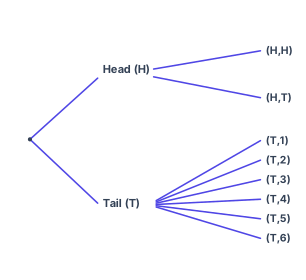
Because the branch outcomes are not equally likely (HT has probability while each T-die outcome has ), the conditional probability that the die shows more than , given at least one tail, is .
Why the outcomes are not equally likely
The experiment branches on the first toss:
- If the coin shows head, we toss the coin again, giving HH or HT.
- If it shows tail, we throw a die, giving T1, T2, T3, T4, T5, T6.
The first toss is fair, so . On the head branch the second toss is fair, so
On the tail branch the die is fair, so each of the six outcomes has
These probabilities sum to , as they should. The eight outcomes are therefore NOT equally likely, so we must use probabilities, not raw counts.
Defining the events
- : the die shows a number greater than , i.e. or . A die is thrown only after a tail, so .
- : there is at least one tail. Every outcome has a tail except HH, so .
Computing the probabilities
: easiest via the complement. The only "no tail" outcome is HH with probability , so …
Unlock everything free for 14 days
- Full step-by-step solutions
- Concept-first explanations
- Methods, shortcuts & mistakes
- PYQ mapping + timed mock tests
Full access for 14 days. No credit card required.