Mathematics · Ch 1 — Relations and Functions
Composition of Functions and Invertible Function
Composition of Functions and Invertible Function
1.4 Composition of Functions and Invertible Function
The Idea of Composition
Two functions that can be applied one after the other can be combined into a single function — their composition. If and , the composition (read "g of f") is a new function from to : apply to an element of to get an element of , then apply to that result to get an element of .
The domain of is and its codomain is ; its range is a subset of .
means "apply first, then ". The order matters — applies first, and the two are generally not the same.
Composition is Not Commutative
Composition of functions is not commutative: in general .
Invertible Functions
A function is called invertible if there exists a function such that
where is the identity function on (defined by for all ) and is the identity function on . The function is called the inverse of , denoted .
A function is invertible if and only if it is one-one and onto (bijective). So to prove a function is invertible without finding its inverse, you can simply show it is one-one and onto.
Key Results on Composition and Invertibility
-
Uniqueness of inverse: If is invertible, its inverse is unique.
-
Composition with identity: For any function ,
- Inverse of composition: If and are both invertible, then is invertible and …
Composition of functions (gof)
Let and be two functions. Their composition (read " of ") is the function defined by
You apply first and feed its output into ; this requires the codomain of to be the domain of . …
Invertible function (inverse f⁻¹)
A function is invertible if there is a function that reverses it:
where and are the identity functions on and . Such a is unique; it is called the inverse of and denoted .
The two conditions say for all and for all — each function undoes the other. A key fact: is invertible if and only if it is both one-one and onto. …
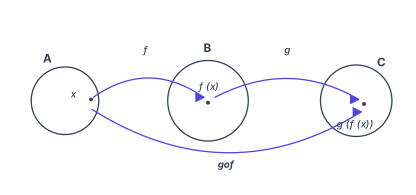
Drawn by us to help you understand the concept clearly, and verified to make sure it's accurate. For exams, practice from your textbook's own diagram.
Fig 1.5 is a visual definition of function composition. It shows three sets, drawn as circles labelled A, B, and C, arranged left to right. Inside each circle sits one representative element: in A, in B, and in C. An arrow labelled arcs over the top from to . A second arrow labelled arcs from to . A third, longer arrow labelled sweeps along the bottom directly from to , skipping the intermediate stop. The diagram makes the chain explicit: you first apply , then , and the composite arrow captures the entire journey in one step.
The physical idea is that composition is a two-stage process that you can treat as a single function. Given and , the composite sends each in A directly to in C. The figure emphasises that the output of becomes the input of — the middle set B is the bridge. Without the diagram, students often confuse the order: means "first , then ", and the arrow from to along the bottom makes that sequence visually unambiguous.
Here and . The symbol is read as "composed with". The domain of is A, and its codomain is C. The formula works only when the range of lies inside the domain of — that is, every must be a valid input for . In the figure, that condition is satisfied because sits inside B, which is exactly the domain of .
A common mistake is to write when you mean . The order matters: applies first, then . The diagram's bottom arrow runs from A to C, not from B to C, so it always starts with the function whose domain is A. …