Physics · Ch 3 — Current Electricity
Wheatstone Bridge
Wheatstone Bridge
What is a Wheatstone Bridge?
The Wheatstone bridge is a special arrangement of four resistors used to measure an unknown resistance very precisely. It is a direct application of Kirchhoff’s rules.
The circuit has four resistors: , , , and , connected in a diamond shape.
- Battery arm: A source (cell) is connected across one pair of opposite corners (A and C).
- Galvanometer arm: A sensitive current-detecting device called a galvanometer (G) is connected across the other pair of opposite corners (B and D).
We assume the cell has no internal resistance for simplicity.
The Key Idea: The Balanced Bridge
The most important case is when the bridge is balanced. This means the resistors are chosen so that no current flows through the galvanometer ().
When , the galvanometer shows a null deflection. This is the condition we aim for.
Deriving the Balance Condition
Let’s label the currents in the arms when the bridge is balanced ():
- Current through =
- Current through =
- Current through =
- Current through =
Step 1: Apply Kirchhoff’s Junction Rule
- At junction D: enters, leaves. Since , we get .
- At junction B: enters, leaves. Since , we get .
Step 2: Apply Kirchhoff’s Loop Rule
Consider two closed loops that do not include the galvanometer (since , its branch has no potential drop).
- Loop ADBA: Going from A → D → B → A. The potential changes are: This gives:
- Loop CBDC: Going from C → B → D → C. Using and , the potential changes are: This gives:
Step 3: Combine the Equations
From Equation 1:
From Equation 2:
Equating the two ratios, we get the balance condition:
Or, more commonly written as:
This is the Wheatstone bridge balance condition. When this relation holds, the galvanometer shows zero current.
Practical Use: Measuring an Unknown Resistance …
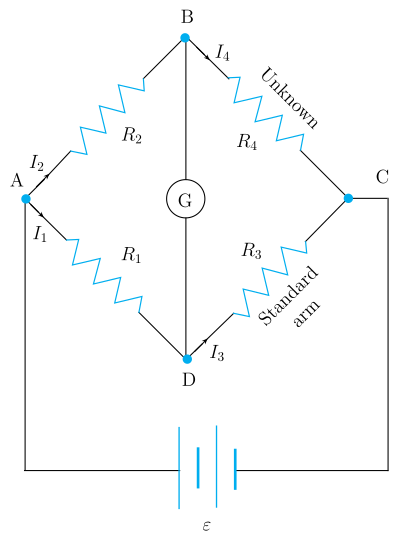
Drawn by us to help you understand the concept clearly, and verified to make sure it's accurate. For exams, practice from your textbook's own diagram.
The figure shows a Wheatstone bridge drawn as a diamond-shaped circuit. The four vertices are labelled A (left), B (top), C (right), and D (bottom). The four arms of the diamond each contain a resistor:
- Arm A→B (upper-left): resistor
- Arm B→C (upper-right): resistor , with the word Unknown written slanted along it
- Arm A→D (lower-left): resistor
- Arm D→C (lower-right): resistor , with the words Standard arm written slanted along it
A galvanometer (drawn as a circle) connects the vertical diagonal B–D — this is the galvanometer arm. Across the horizontal diagonal A–C, external leads drop down to a battery symbol at the bottom — this is the battery arm. Branch currents are labelled: in arm A–D, in arm A–B, in arm D–C, and in arm B–C.
Physical idea
The Wheatstone bridge is a circuit used to measure an unknown resistance by comparing it with known resistances. The key is to adjust the resistances until the galvanometer shows zero current (). This condition is called a balanced bridge. At balance, no current flows through the galvanometer, and the potential difference between B and D is zero.
Key formula derived from the figure
Using Kirchhoff’s rules for the balanced bridge ():
- Junction rule at D and B gives and .
- Loop rule for loop ADBA:
- Loop rule for loop CBDC (using , ):
Dividing the two equations gives the balance condition:
…