Q.(a) What will be the path of a charged particle moving perpendicular to a uniform magnetic field ?
You're viewing a preview — the full solution, concept, methods & PYQ mapping are locked.
Start your 14-day free trial to unlock the full solution →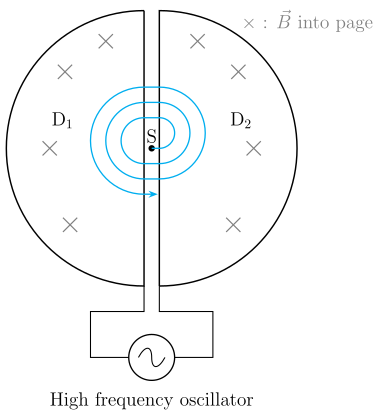
(a) A charge moving perpendicular to a uniform B field feels a force always perpendicular to its velocity, producing uniform circular motion. (b) The cyclotron exploits this to repeatedly accelerate charged particles using dees and an alternating voltage, but is limited by relativistic effects and cannot work for electrons or neutrals.
(a) Path of a charged particle moving perpendicular to a uniform magnetic field:
The magnetic force on a moving charge is , which is always perpendicular to the velocity . A force perpendicular to velocity does no work (doesn't change speed) but continuously changes direction — this is exactly the condition for uniform circular motion. So the particle moves in a circle, of radius , in the plane perpendicular to .
(b) Cyclotron — principle, construction, working, limitations:
Principle: a positively charged particle can be accelerated to high energies using a relatively small alternating voltage applied many times, by making it repeatedly cross the same electric field gap, while a strong perpendicular magnetic field bends it back around in an ever-widening circular/spiral path each time.
Construction: two hollow, D-shaped, semicircular metal electrodes ('dees', D₁ and D₂) are placed facing each other with a small gap between them, housed inside an evacuated chamber. This chamber sits between the poles of a strong electromagnet, producing a uniform magnetic field perpendicular to the plane of the dees. The dees are connected to a high-frequency alternating voltage source. An ion source is placed at the centre.
Working: A positive ion produced at the centre is accelerated across the gap towards whichever dee is momentarily negative. Inside the dee (a field-free region, since it's a hollow conductor), the magnetic field curves it around in a semicircle. By the time it returns to the gap, the polarity of the alternating voltage has reversed, so it is accelerated again across the gap, gaining more speed each time, and moves in a larger-radius semicircle in the next dee. This continues in a spiral path of increasing radius until the ion reaches the edge, where it is extracted at high energy via a deflecting plate.
…
Unlock everything free for 14 days
- Full step-by-step solutions
- Concept-first explanations
- Methods, shortcuts & mistakes
- PYQ mapping + timed mock tests
Full access for 14 days. No credit card required.