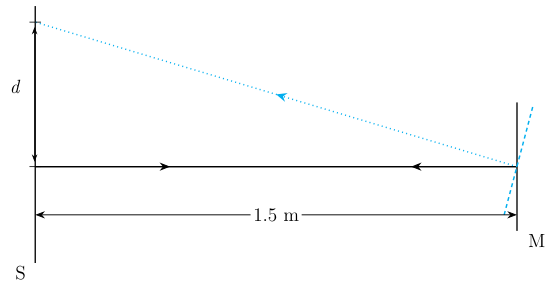
Q.Light incident normally on a plane mirror attached to a galvanometer coil retraces backwards as shown in Fig. 9.29. A current in the coil produces a deflection of of the mirror. What is the displacement of the reflected spot of light on a screen placed away?
You're viewing a preview — the full solution, concept, methods & PYQ mapping are locked.
Start your 14-day free trial to unlock the full solution →A plane mirror rotated by swings the reflected ray through . Here , so the reflected ray rotates by , and the light spot on a screen away shifts by .
Why rotating the mirror doubles the ray's deflection
The law of reflection says the angle of incidence equals the angle of reflection, both measured from the mirror's normal. If the mirror rotates by , its normal also rotates by - but the incident ray (from the fixed light source) doesn't move. So relative to the new normal, the angle of incidence has changed by ; by the law of reflection, the reflected ray moves by on the far side of the new normal too. Both shifts add up, so the reflected ray's total deflection is - independent of the original angle of incidence.
Step 1: find the deflection of the reflected ray
Here light strikes the galvanometer mirror normally, and a current deflects the mirror by . The reflected ray therefore swings by
Step 2: find the displacement on the screen
The screen is at distance , perpendicular to the original (undeflected) ray direction. The reflected ray now makes an angle of with that original direction, so the spot's displacement is the opposite side of a right triangle with adjacent side :
Using :
…
Unlock everything free for 14 days
- Full step-by-step solutions
- Concept-first explanations
- Methods, shortcuts & mistakes
- PYQ mapping + timed mock tests
Full access for 14 days. No credit card required.