Q.With the help of ray diagram, describe the construction, working of a compound microscope when the final image is formed at least distance of distinct vision (D = 25cm). Derive an expression for its magnifying power (m). OR
You're viewing a preview — the full solution, concept, methods & PYQ mapping are locked.
Start your 14-day free trial to unlock the full solution →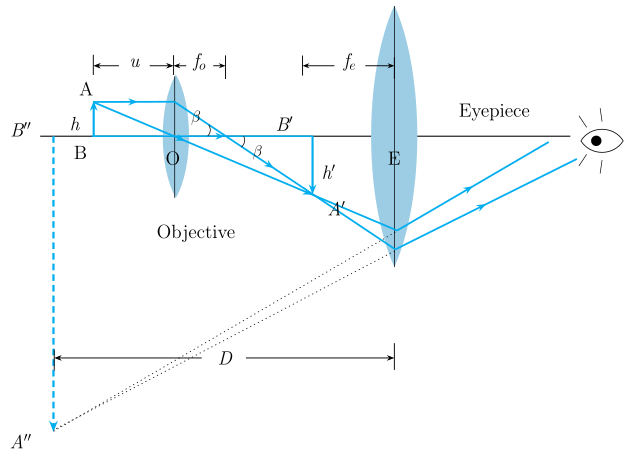
The objective forms a real, magnified, inverted image just inside the eyepiece's focal length; the eyepiece then acts as a simple magnifier on that image, giving overall magnifying power when the final image is at the near point.
Construction: A compound microscope has two convex lenses mounted coaxially at the two ends of a tube: the OBJECTIVE (facing the object), of small aperture and small focal length , and the EYEPIECE (near the eye), of slightly larger focal length , separated by a distance (the tube length).
Working / ray diagram (described): The object O is placed just beyond the objective's focus (), so the objective forms a real, inverted, magnified image a little inside the focal length of the eyepiece. This intermediate image then acts as the 'object' for the eyepiece, which — since lies within the eyepiece's focal length — forms a further magnified, VIRTUAL image that the eye sees. If is formed at the near point (least distance of distinct vision, cm), the eyepiece is essentially working as a simple magnifier in its maximum-magnification configuration.
Magnifying power derivation: Overall magnification is the product of the objective's linear magnification and the eyepiece's angular magnification: …
Unlock everything free for 14 days
- Full step-by-step solutions
- Concept-first explanations
- Methods, shortcuts & mistakes
- PYQ mapping + timed mock tests
Full access for 14 days. No credit card required.