Economics · Ch 16 — Comparative Development Experiences of India and Its Neighbours
Development Strategies—An Appraisal
Development Strategies—An Appraisal
A country's development strategy is often held up as a model for others, especially since reforms spread around the world. To learn from a neighbour's experience we need to understand the roots of its successes and failures, and to distinguish the different phases of its strategy. Taking the start of reforms as a reference point — China in 1978, Pakistan in 1988 and India in 1991 — the pre- and post-reform records can be compared.
China's success
- China reformed on its own initiative, not because the World Bank or IMF required it (as was the case for India and Pakistan). Its new leadership was dissatisfied with slow growth and the lack of modernisation under Maoist rule, feeling that the Maoist model of decentralisation, self-sufficiency and rejection of foreign technology and capital had failed — per capita grain output in 1978 was no higher than in the mid-1950s.
- Yet the groundwork laid before reform proved crucial. Infrastructure in education and health, land reforms, long-standing decentralised planning and many small enterprises had already improved social and income indicators. Basic health services had been extended widely in rural areas, and the commune system distributed foodgrains more equitably.
- Each reform was first tried at a small scale and then extended, letting the government assess the economic, social and political costs before scaling up. Handing farmland to individuals for cultivation, for instance, quickly raised the incomes of many poor people and built support for further reform, feeding rapid growth in rural industries.
Pakistan's difficulties
- Scholars argue that in Pakistan the reform process worsened most economic indicators; growth of GDP and its sectoral parts has not recovered to 1980s levels.
- Although international poverty-line data look healthy, national figures suggest rising poverty: the share of poor fell from over 40 per cent in the 1960s to about 25 per cent in the 1980s, then began climbing again.
- A key weakness was that agricultural growth and food supply depended on the luck of good harvests rather than on steady, institutionalised technical change, so the economy prospered in good harvest years and stagnated otherwise.
- Pakistan relied heavily on remittances from workers in the Middle East and on exports of volatile agricultural goods, along with growing foreign borrowing and increasing difficulty repaying loans.
- In recent years, however, Pakistan has recovered: in 2017–18 GDP grew about 5.5 per cent, the highest in a decade, with industry and services growing about 4.9 and 6.2 per cent while agriculture lagged, and several macroeconomic indicators turned stable and positive.
India's context
India had to borrow from the IMF and World Bank to correct a balance of payments crisis. Foreign exchange is essential for any country, and a nation that can steadily earn it by exporting manufactured goods need not worry — a lesson that contrasts India's position with Pakistan's dependence on remittances and volatile farm exports.
Work These Out
- While India has performed relatively well vis-à-vis other developing countries (including its Asian neighbours) in terms of economic growth, India is yet to show the world that there is considerable progress in terms of human development indicators. Where did India go wrong? Why did we not take care of our human resources? Discuss in the classroom. …
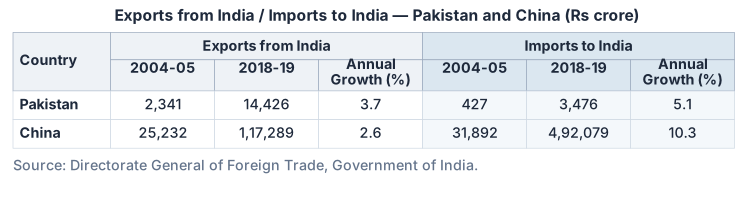
| Country | Exports 2004-05 | Exports 2018-19 | Export Ann. Growth (%) | Imports 2004-05 | Imports 2018-19 | Import Ann. Growth (%) |
|---|---|---|---|---|---|---|
| Pakistan | 2,341 | 14,426 | 3.7 | 427 | 3,476 | 5.1 |
| China | 25,232 | 1,17,289 | 2.6 | 31,892 | 4,92,079 | 10.3 |