Economics · Ch 14 — Employment: Growth, Informalisation and Other Issues
Introduction
Introduction
Mahatma Gandhi
"What I object to is the 'craze' for machinery, not machinery as such. The craze is for what they call labour-saving machinery. Men go on 'saving labour' till thousands are without work and thrown on the open streets to die of starvation..."
— Mahatma Gandhi
Work is central to human life, both for the individual and for society as a whole. People earn a living in many different settings — on farms, in factories, banks and shops — while others work from home. Home-based work is not only the traditional kind such as weaving, lace-making and handicrafts, but increasingly modern too, like software programming for the IT industry. Technology has blurred the old boundary between the city factory and the village home: goods that once had to be made in an urban plant can now be produced at home in a village. The Covid-19 pandemic of 2020–21 pushed this shift dramatically, as millions of workers delivered goods and services through work-from-home arrangements.
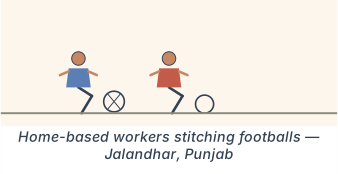
Drawn by us to help you understand the concept clearly, and verified to make sure it's accurate. For exams, practice from your textbook's own diagram.
Own-drawn recreation of NCERT Fig 6.1 (book p.93) — not traced from the real photograph, drawn fresh from its own caption/facts (CLAUDE.md §2/§4).
Why do people work?
The most obvious reason is to earn a living, but work means much more than income. Even people who have money without working for it — for example, through inheritance — do not feel fully satisfied. Being employed gives a person a sense of self-worth and a meaningful place among others. More importantly, every working person adds to the nation's income and therefore to the country's development by taking part in economic activities; this contribution is the deeper meaning of 'earning' a living. People also work out of a sense of responsibility and accomplishment, meeting the needs of those who depend on them.
Mahatma Gandhi recognised the importance of work and insisted on education and training through crafts and other forms of labour. He criticised not machinery itself but the 'craze' for labour-saving machinery, warning that it could throw thousands out of work.
Why study working people?
Studying the working population reveals the quality and nature of employment in a country. It helps in planning human resources, in analysing how different industries and sectors contribute to national income, and in confronting social problems such as the exploitation of marginalised groups and child labour.
Working through this chapter, you should come away able to use the basic vocabulary of employment — economic activity, worker, workforce, unemployment — correctly, to describe how men and women actually participate in different kinds of economic activity, to gauge the real nature and extent of unemployment, and to judge what government initiatives have actually done to expand employment opportunities across sectors and regions.