Economics · Ch 9 — Indian Economy on the Eve of Independence
Foreign Trade
Foreign Trade
India had been an important trading nation since ancient times. Under colonial rule, however, restrictive policies on production, trade and tariffs badly distorted the structure, composition and volume of India's foreign trade.
What India exported and imported
- India became an exporter of primary products — raw silk, cotton, wool, sugar, indigo, jute and the like.
- It became an importer of finished consumer goods such as cotton, silk and woollen cloth, and of capital goods like light machinery made in British factories.
Britain's monopoly
- For all practical purposes Britain controlled both India's exports and its imports.
- More than half of India's foreign trade was tied to Britain; the remainder was allowed only with a few countries such as China, Ceylon (Sri Lanka) and Persia (Iran).
- The opening of the Suez Canal further intensified Britain's grip on Indian trade (see Box 1.3).
Box 1.3: Trade Through the Suez Canal
The Suez Canal is an artificial waterway running north to south across the Isthmus of Suez in north-eastern Egypt, connecting Port Said on the Mediterranean Sea with the Gulf of Suez, an arm of the Red Sea. By doing away with the need to sail all the way around Africa, it gives ships travelling between European or American ports and ports in South Asia, East Africa and Oceania a direct route — strategically and economically one of the most important waterways in the world. Its opening in 1869 cut the cost of transportation and made access to the Indian market easier.
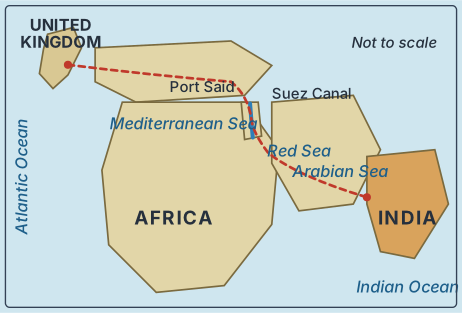
Drawn by us to help you understand the concept clearly, and verified to make sure it's accurate. For exams, practice from your textbook's own diagram.
Our own data-recreation of the trade route the NCERT chapter maps in Fig. 1.2 — a schematic showing how the Suez Canal shortened the sea journey between Britain and India. The country/sea outlines and the canal route are geographic facts; the specific map artwork is drawn fresh by us, not traced from the textbook. See Box 1.3 above for …
Work These Out
- Prepare a list of items that were exported from and imported into India during British rule.
- Collect information from the Economic Survey (Ministry of Finance, Government of India) for various years on India's current exports and imports. Compare these with the exports and imports of the pre-independence era, and also find out the names of the prominent ports that now handle the bulk of India's foreign trade.
The export surplus and the drain of wealth
- The defining feature of colonial-era trade was a large, persistent export surplus — India consistently exported more than it imported. …