Economics · Ch 5 — Measures of Central Tendency
Quartiles
Quartiles
Quartiles are positional measures that divide an ordered distribution into four equal parts, each holding the same number of observations. There are three quartiles:
- First (lower) quartile — 25% of the items lie below it and 75% above it.
- Second quartile — this is simply the median: 50% of items below, 50% above.
- Third (upper) quartile — 75% of the items lie below it and 25% above it. …
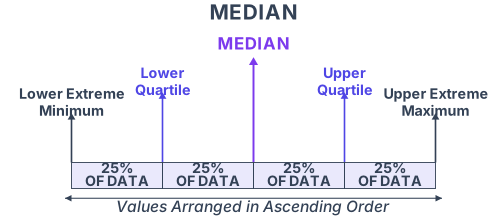
Drawn by us to help you understand the concept clearly, and verified to make sure it's accurate. For exams, practice from your textbook's own diagram.
The figure is a simple number line drawn horizontally. A single continuous line represents the full range of the data, from the smallest value on the left to the largest value on the right. The line is marked with three vertical tick marks that divide it into four distinct segments. These three tick marks are labelled, from left to right, as , , and . The segment from the left end to is the first quarter of the data, from to is the second quarter, from to is the third quarter, and from to the right end is the fourth quarter. The middle tick mark, , is also labelled as the median.
The physical idea is straightforward: just as the median splits the ordered data into two equal halves, quartiles split it into four equal parts. Each of the four intervals contains exactly one-quarter (25%) of the observations. The three dividing points are the first quartile (), the second quartile (, which is the median), and the third quartile (). The figure makes it visually clear that the median is not a separate concept but is actually the middle quartile.
The textbook uses this figure to introduce the formulas for locating quartiles in a discrete data set. For ungrouped data arranged in ascending order, the position of the -th quartile () is given by:
where is the total number of observations. For example, the first quartile () is at position , the median () is at position , and the third quartile () is at position .
The formula uses , not . This is a common source of error. The position is a rank in the ordered list, and the ensures that the median formula matches the familiar rule you already know. …