Physical Education · Ch 7 — Fundamentals of Anatomy and Physiology in Sports
Properties of Skeletal Muscles
Properties of Skeletal Muscles
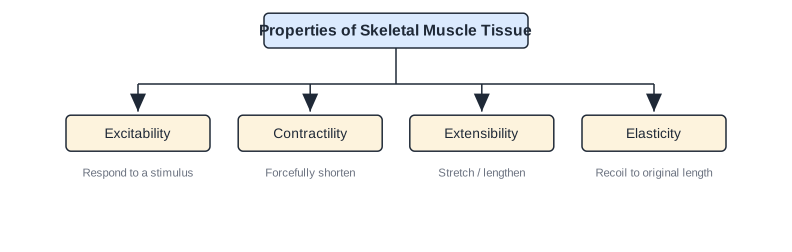
Skeletal muscle has four major functional properties. Together they let the nervous system command a muscle at the right moment, and let the muscle produce force, stretch and spring back without being damaged.
Drawn by us to help you understand the concept clearly, and verified to make sure it's accurate. For exams, practice from your textbook's own diagram.
A chart headed 'Properties of Skeletal Muscle Tissue' with a line dropping to four labelled boxes in a row: Excitability, Contractility, Extensibility and Elasticity. Use the chart as a memory aid for the order in which these properties act during a single movement - a muscle must first be excitable enough to receive the nervous signal, then contractile enough to produce force, then extensible enough to lengthen again afterwards, and elas …
Excitability
Excitability is the ability to respond to a stimulus - a signal that may be delivered by a motor neuron or by a hormone. This responsiveness is what lets a muscle act at exactly the right instant, such as the moment a sprinter reacts to the starting gun. Reaction-time training works directly on this property, sharpening how quickly the nervous signal is received and acted upon.
Contractility
Contractility is the ability of muscle cells to forcefully shorten themselves - the capacity for self-contraction. It is the defining property of muscle and the source of all the force and movement an athlete produces. Strength and resistance training improve contractility over time, both by making individual muscle fibres thicker (hypertrophy) and by improving how efficiently the nervous system recruits them.
Extensibility
Extensibility is the ability of a muscle to stretch, or its capacity to lengthen beyond its resting length - for example when an opposing muscle contracts, or during a stretching exercise, or when a muscle lengthens under control while absorbing a landing. Good extensibility, built through regular stretching and mobility work, allows a joint its full range of motion and is one factor that reduces the risk of a muscle strain.
Elasticity
Elasticity is the ability to recoil, or bounce back to the muscle's original length after being stretched. Like an elastic band, a muscle returns to its resting length once the stretching force is removed. This property is what makes the stretch-shortening cycle possible: a muscle that is stretched rapidly just before it contracts (as in the downward dip before a jump) stores elastic energy and releases it to produce a more powerful contraction immediately afterwards. Plyometric exercises such as depth jumps and bounding are built specifically to train this property.