Biology · Ch 6 — Anatomy of Flowering Plants
Dicotyledonous Stem
Dicotyledonous Stem
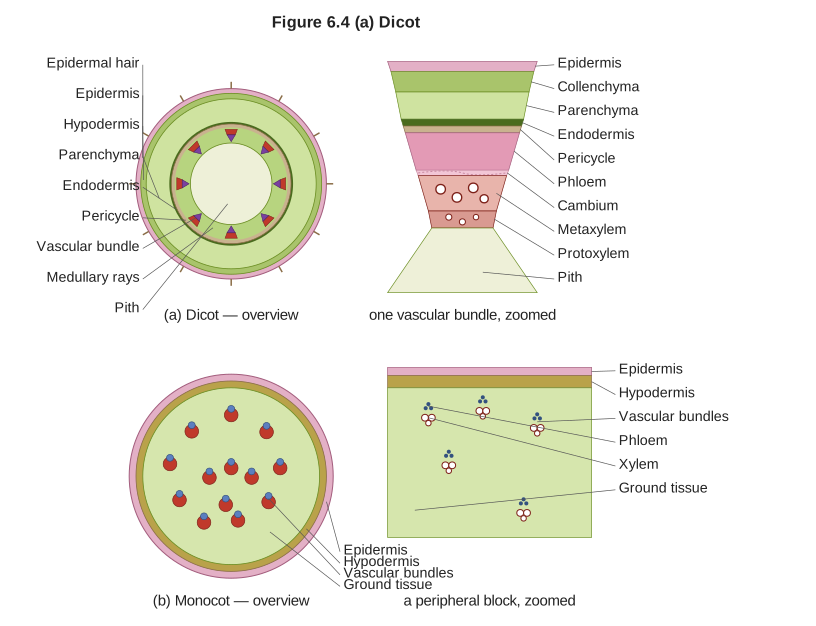
The transverse section of a typical young dicotyledonous stem shows a clear zonation from the outside to the centre.
- The epidermis is the outermost protective layer of the stem. It is covered with a thin layer of cuticle and may bear trichomes and a few stomata.
- The cells arranged in multiple layers between the epidermis and the pericycle constitute the cortex, which consists of three sub-zones:
- the outer hypodermis, made up of a few layers of collenchymatous cells lying just below the epidermis, which provide mechanical strength to the young stem;
- the cortical layers below the hypodermis, consisting of rounded, thin-walled parenchymatous cells with conspicuous intercellular spaces; and
- the innermost layer of the cortex, the endodermis, whose cells are rich in starch grains, so that this layer is also referred to as the starch sheath.
- The pericycle is present on the inner side of the endodermis and above the phloem, in the form of semi-lunar patches of sclerenchyma.
- In between the vascular bundles there are a few layers of radially placed parenchymatous cells which constitute the medullary rays. …
Drawn by us to help you understand the concept clearly, and verified to make sure it's accurate. For exams, practice from your textbook's own diagram.
This figure shows transverse sections of a dicot stem (a) and a monocot stem (b). In the dicot stem the labelled layers, from outside inwards, are epidermis with epidermal hair, hypodermis of collenchyma, cortical parenchyma, endodermis and pericycle; the conjoint, open vascular bundles, each with phloem, cambium, metaxylem and protoxylem, are arranged in a ring, separated by medullary rays, around a central pith. In the monocot stem the labels show epidermis, a sclerenchymatous hypodermis, and numerous vascular bundles scattered throughout a large parenchymatous ground tissue, each bundle showing ** …