Biology · Ch 6 — Anatomy of Flowering Plants
The Vascular Tissue System
The Vascular Tissue System
The vascular tissue system consists of the complex tissues, the phloem and the xylem. Together the xylem and phloem constitute the vascular bundles, which are the conducting channels of the plant.
On the basis of the presence of cambium and the arrangement of xylem and phloem, vascular bundles are of several types:
- Open vascular bundles: In dicotyledonous stems, a strip of meristem called cambium is present between the phloem and the xylem. Because of this cambium such bundles retain the ability to form secondary xylem and secondary phloem, and are therefore called open.
- Closed vascular bundles: In monocotyledons the vascular bundles have no cambium present in them. Since they cannot form secondary tissues, they are referred to as closed.
- Radial bundles: When the xylem and phloem within a vascular bundle are arranged in an alternate manner along the different radii of the organ, the arrangement is called radial, such as is found in roots. …
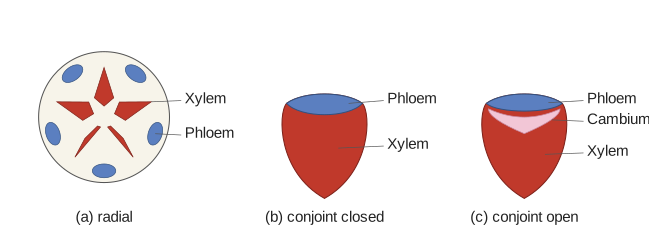
Drawn by us to help you understand the concept clearly, and verified to make sure it's accurate. For exams, practice from your textbook's own diagram.
This figure contrasts three arrangements of xylem and phloem within a vascular bundle. In part (a), the radial type, the xylem and phloem lie on separate, alternating radii rather than together; this arrangement is characteristic of roots. In part (b), a conjoint closed bundle, the phloem sits on the outer side and the xylem on the inner side along the same radius, and there is no cambium between them, so no secondary tissue can form; this is typical of monocot stems. In part (c), a conjoint open bundle, the phloem and xylem again lie along one radius but a band of cambium is present …