Question of 54
Q.Draw a labelled diagram of human heart and write the names of two disorders of circulatory system.
Rajasthan RbseRajasthan Board Senior Secondary Part-I Examination 2026Subjective· 3mImportance★★★★★
0% · 0/54 Questions
You're viewing a preview — the full solution, concept, methods & PYQ mapping are locked.
Start your 14-day free trial to unlock the full solution →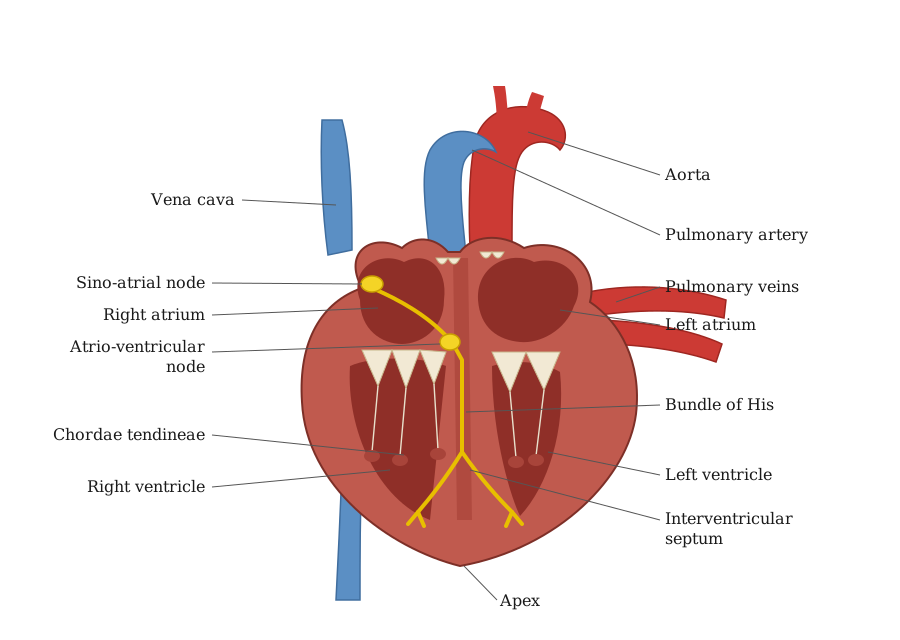
The human heart has four chambers, valves and major vessels arranged for one-way double circulation; hypertension and coronary artery disease (atherosclerosis) are two important circulatory disorders.
Structure of the human heart (described here for the diagram, since it cannot be hand-drawn in text):
- The heart is a four-chambered, roughly cone-shaped, muscular organ enclosed in a double-walled pericardium, located in the thoracic cavity.
- Upper chambers: right atrium and left atrium, which receive blood.
- Lower chambers: right ventricle and left ventricle, which pump blood out; the ventricle walls are thicker than the atrial walls, and the left ventricle wall is the thickest of all (it pumps blood to the whole body).
- The right and left halves are separated by the interatrial septum (between atria) and interventricular septum (between ventricles).
- Major vessels: superior and inferior vena cava (bring deoxygenated blood into the right atrium), pulmonary artery (carries deoxygenated blood from right ventricle to lungs), pulmonary veins (bring oxygenated blood from lungs to left atrium), and the aorta (carries oxygenated blood from left ventricle to the body).
- Valves ensure one-way flow: tricuspid valve (right atrium → right ventricle), bicuspid/mitral valve (left atrium → left ventricle), and the semilunar valves guarding the exits of the pulmonary artery and aorta. …
Unlock everything free for 14 days
- Full step-by-step solutions
- Concept-first explanations
- Methods, shortcuts & mistakes
- PYQ mapping + timed mock tests
Full access for 14 days. No credit card required.