The Potato Family: Solanaceae
You already know a potato. You know a tomato, a brinjal (aubergine), a chilli pepper. What if I told you these very different-looking vegetables are botanical cousins? That is the first intuition behind the family Solanaceae — it is the potato family, and it contains some of the most important food crops on Earth.
But the family also includes deadly nightshade (Atropa belladonna) and tobacco (Nicotiana tabacum). So this is a family of extremes: dinner and poison, medicine and addiction. The key is learning the diagnostic features that let you recognise any member of this family, whether it is a potato plant in a field or a wild Solanum weed.
The precise statement
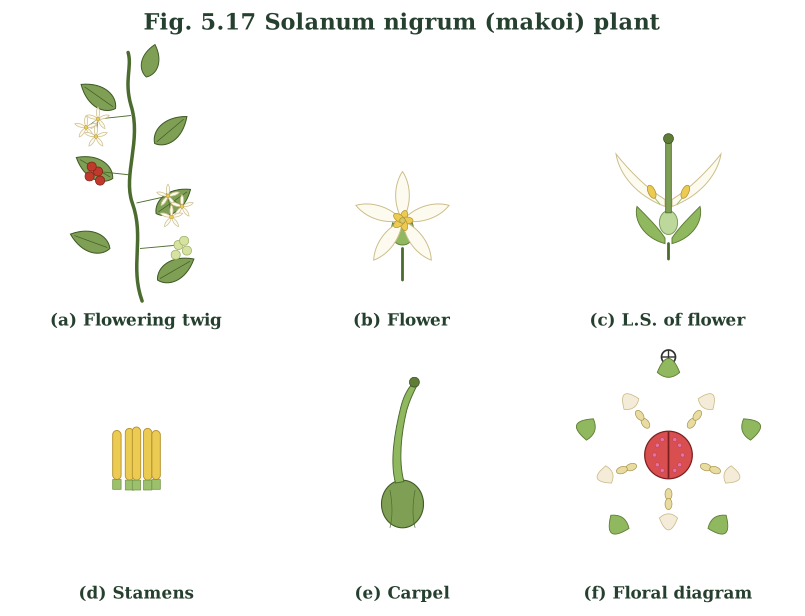
Family Solanaceae (the potato or nightshade family) is a family of flowering plants characterised by herbs or shrubs, alternate leaves, actinomorphic (radially symmetric) bisexual flowers with 5 fused sepals, 5 fused petals, 5 epipetalous stamens, and a bicarpellary syncarpous ovary with axile placentation. The fruit is typically a berry or a capsule.
That is the textbook definition. Now let us break it down so you never forget it.
The flower: a 5-part blueprint
Pick any Solanaceae flower — a tomato flower, a brinjal flower, a chilli flower. They all follow the same plan:
- Calyx: 5 sepals, fused together (gamosepalous). They often persist even after the fruit forms — you see the little green star at the top of a tomato? That is the calyx.
- Corolla: 5 petals, fused (gamopetalous). The shape varies — bell-like in potato, star-shaped in tomato, tubular in tobacco — but always 5.
- Androecium (stamens): 5 stamens. Here is the critical detail: they are epipetalous — attached to the petals, not to the receptacle. If you gently pull a petal from a brinjal flower, the stamen comes with it.
- Gynoecium (pistil): 2 carpels fused together (bicarpellary, syncarpous). The ovary is superior (above the attachment of other floral parts).
The number 5 is your memory anchor. Sepals 5, petals 5, stamens 5. If you see a flower with parts in fives, you are already suspicious of Solanaceae.
Axile placentation: the central column
Now the most important internal feature. Cut a tomato crosswise — you see those seed chambers radiating from the centre? That is axile placentation.
In axile placentation, the ovary is divided into chambers (locules) by walls that meet at the centre. The ovules (future seeds) are attached along the central column where these walls join. For Solanaceae, with 2 fused carpels, you typically get 2 locules — though in cultivated tomatoes, breeding has increased this to many.
Compare this with marginal placentation (pea family — seeds along one edge) or parietal placentation (mustard family — seeds on the ovary wall). Axile means "axle" — think of a wheel's axle with spokes radiating out. The seeds sit on that central axle.
Do not confuse axile with free central placentation. In free central, the central column stands free from the ovary wall (e.g., primrose family). In axile, the column is connected to the wall by septa (walls). Solanaceae is axile, not free central.
Epipetalous stamens: why it matters
"Epipetalous" means "upon the petals". The stamens arise from the corolla tube rather than from the base of the flower. This is a diagnostic character — not many families have it.
Why does this happen? In fused-petal flowers, the stamens often fuse to the corolla tube during development. It is an evolutionary strategy: the stamens are positioned precisely where a pollinator's body will brush against them when it reaches for nectar at the flower's base.
In Solanaceae, the 5 epipetalous stamens alternate with the corolla lobes. They are often didynamous (2 longer, 2 shorter, 1 medium) in some genera, but the key exam point is simply: 5 stamens, epipetalous.
The fruit: berry or capsule
After fertilisation, the ovary develops into fruit. Solanaceae gives you two main types:
- Berry: fleshy, many-seeded. Tomato, brinjal, chilli, potato (yes, the potato tuber is a stem, but the fruit of the potato plant is a small green berry — poisonous!).
- Capsule: dry, splitting open when ripe. Tobacco, Datura (thorn apple).
The potato we eat is a modified stem (tuber), not a fruit. The fruit of the potato plant is a small berry that you should never eat — it contains solanine, a toxic alkaloid.
Vegetative features: leaves and stem
Solanaceae plants are mostly herbs (tomato, chilli) or shrubs (brinjal), rarely trees. The leaves are alternate (one leaf per node), simple (not divided into leaflets), and often have a characteristic smell when crushed — think of tomato leaves.
Many members have stellate (star-shaped) hairs on the stem and leaves, giving them a rough texture. This is a useful field character but not always tested.
--- …