Biology · Ch 5 — Morphology of Flowering Plants
Solanaceae
Solanaceae
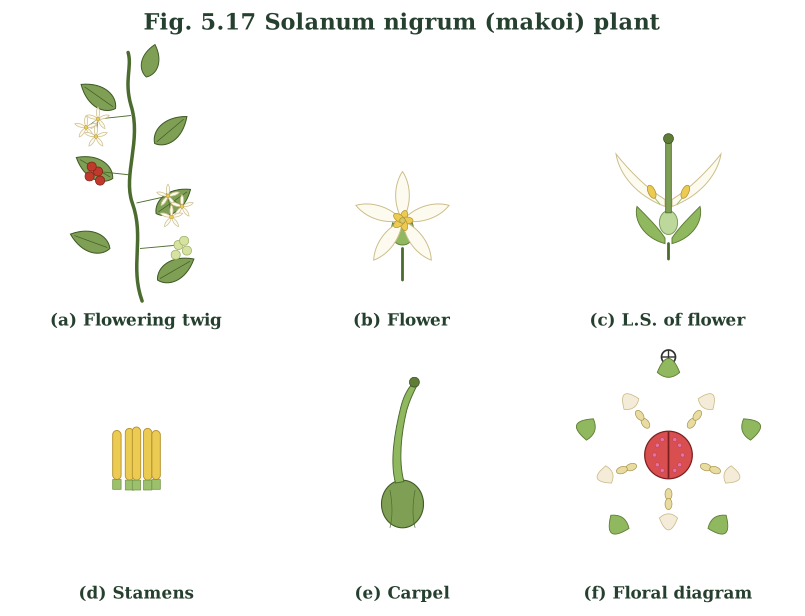
Solanaceae is a large family, commonly called the 'potato family'. It is widely distributed in tropics, subtropics and even the temperate zones, and includes several plants of great economic importance. Solanum nigrum (makoi) is taken as a representative plant of the family.
Vegetative characters
- Habit: plants are mostly herbs, shrubs and rarely small trees.
- Stem: herbaceous, rarely woody, aerial; erect, cylindrical, branched, solid or hollow, hairy or glabrous; the stem is underground in potato (Solanum tuberosum).
- Leaves: alternate, simple, rarely pinnately compound, exstipulate; venation reticulate.
Floral characters
- Inflorescence: solitary, axillary or cymose.
- Flower: bisexual, actinomorphic.
- Calyx: of five sepals, united (gamosepalous), persistent; valvate aestivation.
- Corolla: of five petals, united (gamopetalous); valvate aestivation.
- Androecium: of five stamens, epipetalous (attached to the petals).
- Gynoecium: bicarpellary, obliquely placed, syncarpous; ovary superior, bilocular, the placenta swollen with many ovules; placentation axile.
- Fruits: a berry or a capsule.
- Seeds: many, endospermous.
Floral formula (in words): the flower is actinomorphic and bisexual; calyx of five united sepals; corolla of five united petals; androecium of five epipetalous stamens; gynoecium bicarpellary, syncarpous, with a superior ovary of two united carpels.
Economic importance
- Food: many plants belonging to this family are sources of food — tomato, brinjal and potato. …
Drawn by us to help you understand the concept clearly, and verified to make sure it's accurate. For exams, practice from your textbook's own diagram.
This figure presents Solanum nigrum, commonly called makoi, as the model plant used to describe the family Solanaceae, across six panels. (a) shows a flowering twig with its leaves and axillary clusters of small white flowers. (b) shows a single flower from the outside. (c) is a longitudinal section (L.S.) of the flower, cut open to show the calyx, corolla and stamens attached to the corolla tube around the central pistil. (d) shows the stamens grouped together, each a slender filament topped by an anther. (e) shows a single carpel isolated, with its swollen basal ovary tapering to a style and stigma. (f) is the floral diagram, a circular schematic showing the whorls of sepals, petals, stamens and the central bilocular ovary, marked actinomorphic. Because this plant carries the typ …