Biology · Ch 3 — Plant Kingdom
Gymnosperms
Gymnosperms
Gymnosperms are seed-bearing plants whose defining feature is written into their name: gymnos means naked and sperma means seed. In these plants the ovules sit exposed on the plant rather than being tucked inside a protective ovary wall, and they stay uncovered both before and after fertilisation. Because no ovary encloses them, the seeds that form after fertilisation are also left naked. This single characteristic — exposed ovules maturing into uncovered seeds — is what separates gymnosperms from the flowering plants and gives them their common label of naked-seeded plants.
Form and size
Gymnosperms are woody plants that vary a great deal in stature. Some are shrubs, some are medium-sized trees, and others grow into tall trees. Among them is the giant redwood, Sequoia, which ranks among the tallest tree species on Earth. So the group spans everything from modest shrubs to forest giants.
Roots
The root system is generally a tap root, but two special adaptations are worth noting:
- In Pinus, the roots form an association with fungi known as mycorrhiza, a partnership that helps the plant absorb nutrients.
- In Cycas, some roots develop into small specialised structures called coralloid roots, which host nitrogen-fixing cyanobacteria that supply the plant with usable nitrogen.
Stems and leaves
The stem may be unbranched, as in Cycas, or branched, as in Pinus and Cedrus. Leaves range from simple to compound; in Cycas the pinnate (feather-like) leaves stay on the plant for several years.
A striking feature of gymnosperm leaves is how well they are built to survive harsh conditions — extremes of temperature, humidity and wind. In the conifers, the leaves are reduced to slender needles, which cuts down the exposed surface area. On top of that, a thick waxy cuticle and stomata that are sunk into pits below the leaf surface both work to limit the loss of water. These traits let gymnosperms hold their ground in dry, cold or windy habitats.
Reproduction: heterospory and cones
Gymnosperms are heterosporous, meaning they make two different kinds of haploid spores — the smaller microspores and the larger megaspores. Both types are produced inside sporangia, and these sporangia are carried on leaf-like structures called sporophylls. The sporophylls are arranged in a spiral along a central axis to build up structures known as strobili or cones, which may be loose (lax) or tightly packed (compact).
- Male strobili (microsporangiate cones): these bear microsporophylls with microsporangia. Inside the microsporangia the microspores develop, and each microspore matures into an extremely reduced male gametophyte — a body confined to just a few cells. This tiny male gametophyte is the pollen grain, and it develops while still inside the microsporangium.
- Female strobili (macrosporangiate cones): these carry megasporophylls that bear the ovules or megasporangia.
The two kinds of cones may occur on the same plant, as in Pinus. In Cycas, however, the male cones and the megasporophylls are borne on separate trees.
From ovule to naked seed
Within the ovule, a megaspore mother cell is set apart from one of the cells of the nucellus. The nucellus is wrapped in protective envelopes, and this whole package — nucellus plus envelopes — is what is called the ovule. Ovules are carried on megasporophylls, which may be clustered together into female cones.
The megaspore mother cell divides by meiosis to give four megaspores. One of these, still held inside the megasporangium, grows into a multicellular female gametophyte that bears two or more archegonia (the female sex organs). This female gametophyte, too, stays enclosed within the megasporangium. …
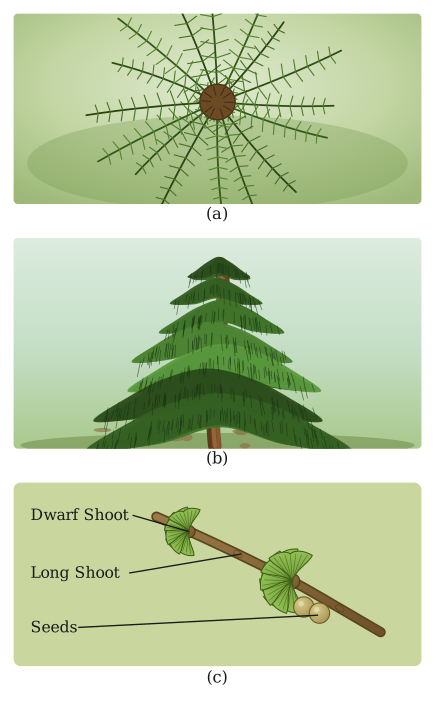
Drawn by us to help you understand the concept clearly, and verified to make sure it's accurate. For exams, practice from your textbook's own diagram.
This plate shows examples of gymnosperms — plants whose seeds are 'naked', borne exposed on the sporophylls rather than enclosed in a fruit. (a) Cycas is shown as a close-up of its crown: a rosette of large, pinnately divided (feather-like) leaves radiating outward.
(b) Pinus is shown as a whole conifer tree with its characteristic needle-shaped foliage; this particular photograph is a plain tree shot and does not itself show a seed cone, even though Pinus is a genuine cone-bearing gymnosperm elsewhere in its life. …