Biology · Ch 12 — Respiration in Plants
Fermentation
Fermentation
In fermentation, say by yeast, the incomplete oxidation of glucose is achieved under anaerobic conditions by sets of reactions where pyruvic acid is converted to CO2 and ethanol. The enzymes pyruvic acid decarboxylase and alcohol dehydrogenase catalyse these reactions. Other organisms, like some bacteria, produce lactic acid from pyruvic acid. In animal cells too, such as muscles during exercise, when oxygen is inadequate for cellular respiration, pyruvic acid is reduced to lactic acid by lactate dehydrogenase. In both these processes the reducing agent is NADH + H+, which is reoxidised to NAD+.
In both lactic acid and alcoholic fermentation not much energy is released:
- Less than seven per cent of the energy in glucose is released, and not all of it is trapped as high-energy bonds of ATP.
- There is a net gain of only two molecules of ATP for each molecule of glucose degraded to pyruvic acid (calculated as the ATP synthesised minus the ATP utilised during glycolysis).
- The processes are hazardous, since either acid or alcohol is produced. Yeasts poison themselves to death when the concentration of alcohol reaches about 13 per cent. This limits the maximum concentration of alcohol in beverages that are naturally fermented; beverages of higher alcohol content are obtained by distillation.
Comparing fermentation and aerobic respiration:
- Fermentation accounts for only a partial breakdown of glucose, whereas in aerobic respiration it is completely degraded to CO2 and H2O. …
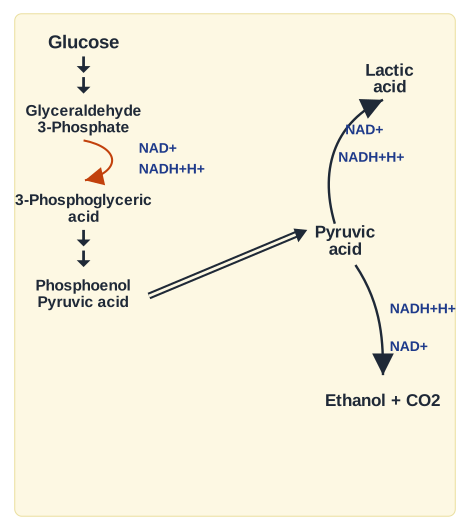
Drawn by us to help you understand the concept clearly, and verified to make sure it's accurate. For exams, practice from your textbook's own diagram.
This diagram shows the two fates of pyruvate when oxygen is absent, both branching from glycolysis. Glucose is broken through glyceraldehyde-3-phosphate to 3-phosphoglyceric acid and on to phosphoenolpyruvic acid, reducing NAD+ to NADH + H+. From pyruvic acid, one branch is alcoholic fermentation, giving ethanol + CO2, and the other is lactic acid fermentation, giving lactic acid. In each branch the NADH + H+ produced during glycolysis is reoxidised back to NAD+, which keeps glycolysis running. The scheme highlights that fermentation is a …