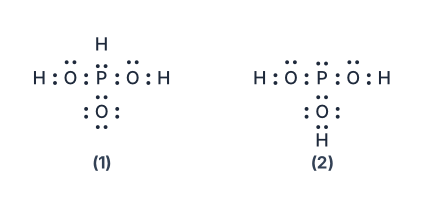
Q. can be represented by structures 1 and 2 shown below. Can these two structures be taken as the canonical forms of the resonance hybrid representing ? If not, give reasons for the same.
You're viewing a preview — the full solution, concept, methods & PYQ mapping are locked.
Start your 14-day free trial to unlock the full solution →Structures (1) and (2) of are not resonance/canonical forms, because they differ in atomic connectivity — structure (1) has a hydrogen bonded directly to phosphorus (a P–H bond), while structure (2) has that same hydrogen bonded to oxygen instead. Resonance structures may only differ in the placement of electrons; the atomic skeleton must stay identical, so these two are different tautomers.
What resonance actually requires
Two (or more) Lewis structures qualify as resonance/canonical forms of the same species only if they satisfy one strict rule: every atom occupies exactly the same position in every structure — only the electrons (bonding pairs, lone pairs) are redistributed. If moving from one structure to the other requires relocating even a single atom, the two structures represent different chemical species (isomers or tautomers), not resonance forms of one species.
Reading the two given structures
Structure (1): phosphorus is bonded to one hydrogen directly (a P–H bond), two –O–H groups, and one terminal oxygen — written out, . All three of the molecule's hydrogens are accounted for: one sits directly on phosphorus, and two sit on oxygen.
Structure (2): phosphorus is bonded to three –O–H groups only — — with a lone pair on phosphorus and no direct P–H bond at all. Here all three hydrogens sit on oxygen.
The key difference
Compare the two atom by atom. The molecular formula () and the overall bonding framework (one P, three O, three H) are the same in both — but the specific hydrogen that in structure (1) is bonded straight to phosphorus is, in structure (2), instead bonded to the third oxygen. Getting from (1) to (2) means physically moving that hydrogen atom from P to O — this is not something resonance can do. Resonance only ever moves π electrons or lone pairs; it never moves a σ-bonded atom.
Why this means they're not resonance forms
Because the atomic connectivity differs, structures (1) and (2) describe two chemically distinct species — a proton (H⁺) has effectively migrated from phosphorus to oxygen. This makes them tautomers: isomers that interconvert by the movement of a single atom (usually H), not resonance contributors of one hybrid structure. …
Unlock everything free for 14 days
- Full step-by-step solutions
- Concept-first explanations
- Methods, shortcuts & mistakes
- PYQ mapping + timed mock tests
Full access for 14 days. No credit card required.