Q.(i) The molecule of AlCl3 is covalent while AlF3 is ionic. Why?
You're viewing a preview — the full solution, concept, methods & PYQ mapping are locked.
Start your 14-day free trial to unlock the full solution →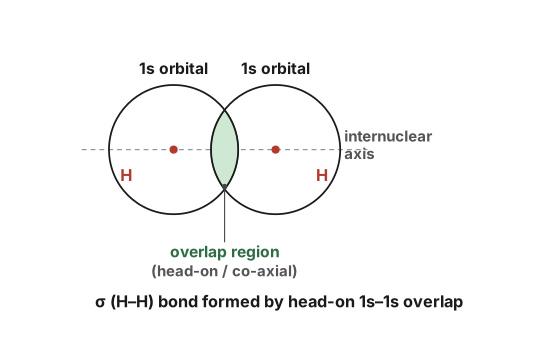
AlCl3 is covalent and AlF3 is ionic due to Fajans' rules on ion polarisation; the octet rule has real limitations (incomplete octet, expanded octet, odd-electron species); and the H2 molecule forms by head-on overlap of two 1s orbitals into a sigma bond.
- AlCl3 (covalent) vs AlF3 (ionic): Al3+ is a small, highly-charged cation with strong polarising power (it strongly attracts and distorts the electron cloud of a nearby anion). According to Fajans' rules, a bond shows more covalent character when the cation is small/highly charged AND the anion is large and easily polarisable. Cl− is a comparatively large, polarisable ion, so its electron cloud gets significantly distorted (pulled) toward Al3+, giving AlCl3 substantial covalent character. F−, by contrast, is very small and has high electronegativity, making it far less polarisable — it resists having its electron cloud distorted, so AlF3 retains predominantly ionic character.
- Octet rule: Atoms tend to gain, lose, or share electrons so as to have eight electrons in their outermost (valence) shell, attaining a stable noble-gas-like electronic configuration. Limitations:
- Incomplete octet: some central atoms are stable with fewer than 8 electrons, e.g., BeCl2 (4 electrons around Be), BF3 (6 electrons around B).
- Expanded octet: some central atoms (usually from period 3 onward, which have accessible d-orbitals) accommodate more than 8 electrons, e.g., PCl5 (10 electrons around P), SF6 (12 electrons around S).
- Odd-electron molecules: species with an odd total number of valence electrons cannot have all atoms satisfy the octet, e.g., NO, NO2, ClO2.
- It does not explain the shape/geometry of molecules or their relative energies/stabilities, and it ignores the role of orbital overlap and energy considerations.
(iii) Overlapping and formation of H2: When two atoms approach each other closely, atomic orbitals containing an unpaired electron each (with opposite spins) can merge/overlap in the region between the two nuclei; this is called orbital overlap. The overlap increases the electron density in the region between the two nuclei, and this concentrated negative charge attracts both positively charged nuclei, holding the atoms together as a covalent bond. …
Unlock everything free for 14 days
- Full step-by-step solutions
- Concept-first explanations
- Methods, shortcuts & mistakes
- PYQ mapping + timed mock tests
Full access for 14 days. No credit card required.