Chemistry · Ch 9 — Hydrocarbons
Alkanes
Alkanes
The Alkane Family: Saturated Hydrocarbons
Alkanes are the simplest family of organic compounds. They are saturated, open-chain (acyclic) hydrocarbons — meaning every carbon atom is bonded to four other atoms (all single bonds), and the carbon chain is not a ring. The first member is methane, , a gas found in coal mines and marshy places where organic matter decays without oxygen.
To see how the family grows, imagine replacing one hydrogen atom of methane with a carbon atom. That carbon must form four bonds. It already has one bond to the original carbon, so it needs three more bonds — to three hydrogen atoms. The result is , ethane. In other words, ethane is methane with one hydrogen replaced by a group. Repeat this process: replace a hydrogen in ethane with another group, and you get , propane. Continue this theoretical exercise, and the next molecules are , , and so on.
This "replace a hydrogen with a group" is the core idea of a homologous series — each step adds one carbon and two hydrogens.
The General Formula
If you examine the formulas of the first few alkanes:
| Name | Molecular Formula | n |
|---|---|---|
| Methane | 1 | |
| Ethane | 2 | |
| Propane | 3 | |
| Butane | 4 | |
| Pentane | 5 |
a clear pattern emerges. For carbon atoms, the number of hydrogen atoms is always . This gives the general formula for the alkane homologous series:
This single formula represents any alkane — just substitute the appropriate value of (a positive integer). For example, gives (hexane), gives (decane).
Structure of Alkanes: Tetrahedral Geometry
Recall the structure of methane from VSEPR theory (Unit 4). Carbon has four bonding pairs of electrons and no lone pairs, so the electron pairs repel each other to the maximum distance. The result is a tetrahedral geometry: the carbon atom lies at the centre, and the four hydrogen atoms occupy the four corners of a regular tetrahedron.
All bond angles are exactly . This is the characteristic bond angle for hybridised carbon.
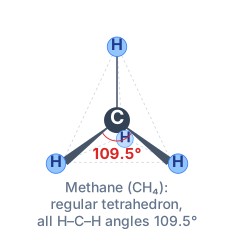
Drawn by us to help you understand the concept clearly, and verified to make sure it's accurate. For exams, practice from your textbook's own diagram.
Fig. 9.1 is a structural diagram of a single methane molecule, CH₄. It shows a regular tetrahedron: a central carbon atom at the geometric centre, with four hydrogen atoms at the four corners. All six edges of the tetrahedron are equivalent, and the four faces are equilateral triangles. The diagram explicitly labels the H–C–H bond angle as 109.5°, and it makes clear that every such angle in the molecule is identical.
The physical idea the figure teaches is that the four bonds in methane are not arranged in a flat, square shape (which would give 90° angles) but point to the corners of a three-dimensional tetrahedron. This is the direct consequence of the carbon atom using four equivalent hybrid orbitals, each of which repels the others equally, pushing them as far apart as possible in three dimensions. The maximum separation for four points on a sphere is 109.5°, not 90°.
The textbook uses this figure to ground the geometry of the simplest alkane before extending the idea to longer chains. The key formula that emerges from this discussion is the general formula for the alkane homologous series:
Here, is the number of carbon atoms in the chain. For methane, , giving . For ethane, , giving , and so on. The formula is derived by the textbook through a thought experiment: starting from methane, replace one hydrogen with a –CH₃ group to get ethane, then repeat the process. Each replacement adds one carbon and two hydrogens, which is exactly the increment that defines a homologous series. …
…