Chemistry · Ch 7 — Redox Reactions
Redox Reactions in Terms of Electron Transfer Reactions
Redox Reactions in Terms of Electron Transfer Reactions
The classical definitions of oxidation and reduction — based on addition or removal of oxygen or hydrogen — work well for many reactions, but they fail to explain what is fundamentally happening at the atomic level. Consider the formation of sodium chloride:
Sodium is oxidised because oxygen (or a more electronegative element, chlorine) is added to it. Chlorine is reduced because the electropositive element sodium is added to it. But this description tells us nothing about the actual electron movements.
We know from chemical bonding that NaCl is an ionic compound, better written as . Similarly, is and is . The appearance of charges on the products gives us a crucial clue: electrons are being transferred from one species to another.
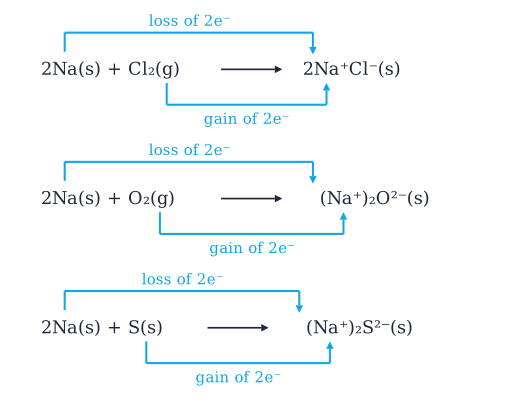
Drawn by us to help you understand the concept clearly, and verified to make sure it's accurate. For exams, practice from your textbook's own diagram.
The chapter redraws reactions 7.12–7.14 with their electron book-keeping made visible: in each case the sodium atoms lose 2e⁻ (the upper arrow) and the non-metal — chlorine, oxygen or sulphur — gains 2e⁻ (the lower arrow). The pairs of arrows make the central point of this section graphic: the electrons lost by the species being oxidised are exactly the electrons gained b …
Splitting the Reaction into Half-Reactions
For convenience, any redox reaction can be thought of as two separate steps — one involving the loss of electrons and the other the gain of electrons. Each of these steps is called a half-reaction, and it explicitly shows the involvement of electrons.
Take the formation of sodium chloride again. The overall reaction is:
We can split it into two half-reactions:
- Oxidation half-reaction (loss of electrons):
- Reduction half-reaction (gain of electrons):
Adding these two half-reactions gives back the overall reaction:
The same logic applies to the other reactions mentioned:
can be split as:
- Oxidation:
- Reduction:
And for:
- Oxidation:
- Reduction:
The half-reactions are written with gaseous ions for conceptual clarity. In the actual solid compound, the ions are held together in a crystal lattice, but the electron transfer is the same.
Redefining Oxidation and Reduction
The half-reaction approach leads to a much more fundamental definition:
- Oxidation is the loss of electron(s) by any species.
- Reduction is the gain of electron(s) by any species.
This definition is universal — it works for reactions that involve no oxygen or hydrogen at all. It also directly connects to the classical idea: when a substance gains oxygen, it is usually losing electrons to the oxygen atom; when it loses hydrogen, it is often losing electrons to the hydrogen atom.
Oxidising and Reducing Agents
Once we define oxidation and reduction in terms of electron transfer, the roles of the reacting species become clear:
- An oxidising agent (or oxidant) is the acceptor of electron(s). It gets reduced in the process.
- A reducing agent (or reductant) is the donor of electron(s). It gets oxidised in the process.
In the reaction :
- Sodium donates electrons — it is the reducing agent (and is oxidised).
- Chlorine accepts electrons — it is the oxidising agent (and is reduced).
In :
- Sodium is the reducing agent.
- Oxygen is the oxidising agent.
In :
- Sodium is the reducing agent.
- Sulphur is the oxidising agent. …