Chemistry · Ch 1 — Some Basic Concepts of Chemistry
States of Matter
States of Matter
The Three States of Matter
Matter around us exists in three familiar physical forms: solid, liquid, and gas. What distinguishes these states is not the kind of particles (atoms or molecules) they are made of, but how those particles are arranged and how much freedom they have to move.
Drawn by us to help you understand the concept clearly, and verified to make sure it's accurate. For exams, practice from your textbook's own diagram.
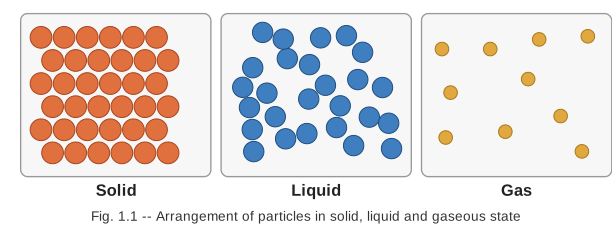
Fig. 1.1 shows, side by side, how closely the particles of a substance are packed and how free they are to move in each of the three states. In the solid panel the particles form a tight, regular arrangement with almost no gaps -- this is why a solid holds both a fixed shape and a fixed volume. In the liquid panel the particles are still touching but no longer locked into a regular pattern -- they can slide past one another, which is why a liquid flows and takes the shape of its container while keeping a fixed volume. In the gas panel the particles are far apart with empty space between them -- this is wh …
In a solid, the constituent particles are packed extremely close together. They are held in fixed positions by strong interparticle forces, forming a regular, orderly arrangement. This tight packing means the particles can only vibrate about their fixed positions; they cannot move past one another. As a result, a solid has both a definite shape and a definite volume — it does not need a container to hold its shape.
In a liquid, the particles are still quite close to each other, but the interparticle forces are weaker than in a solid. The particles have enough energy to slide past one another, though they remain in contact. This gives a liquid a definite volume (the particles stay together) but no definite shape — it flows and takes the shape of the container it is placed in.
In a gas, the particles are very far apart compared to those in solids or liquids. The interparticle forces are negligible, and the particles move rapidly and freely in all directions, colliding with one another and with the walls of any container. Because the particles are so widely spaced and in constant motion, a gas has neither a definite volume nor a definite shape. It expands to completely fill the container it occupies.
The key difference in a nutshell: solids resist changes in both shape and volume; liquids resist changes in volume but not shape; gases resist neither.
Characteristics of Each State
The textbook lists three fundamental properties that follow directly from the particle arrangements described above.
Property (i): Solids have definite volume and definite shape.
Because the particles are locked into a rigid, orderly structure, the solid maintains its own shape regardless of the container. Its volume is fixed because the particles cannot be pushed closer together under ordinary conditions.
Property (ii): Liquids have definite volume but do not have definite shape. They take the shape of the container in which they are placed.
The particles in a liquid are still close enough that the liquid cannot be compressed easily — its volume remains constant. However, the particles can slide over one another, so the liquid flows and adopts the shape of its container, forming a horizontal surface.
Property (iii): Gases have neither definite volume nor definite shape. They completely occupy the space in the container in which they are placed.
Gas particles are far apart and move freely. They spread out to fill every part of the container, so the volume of the gas is the volume of the container. The gas has no shape of its own; it takes the shape of the container entirely.
Interconversion of States
These three states are not fixed forever. By changing the temperature or the pressure (or both), matter can be converted from one state to another.
On heating a solid, the particles gain kinetic energy. When the energy is enough to overcome the forces holding them in fixed positions, the solid melts into a liquid. Heating the liquid further gives the particles even more energy, and they break free from each other entirely, turning into a gas (or vapour). …